Stack
In this lesson we will learn about our first real data structure - the Stack!
Imagine a stack of plates. You can only do two things with it:
- put a new plate on top
- take the plate from the top
You can't pull a plate from the middle without everything crashing down. That is the entire idea of a stack: the last element that came in is the first one to come out (LIFO - Last In, First Out).
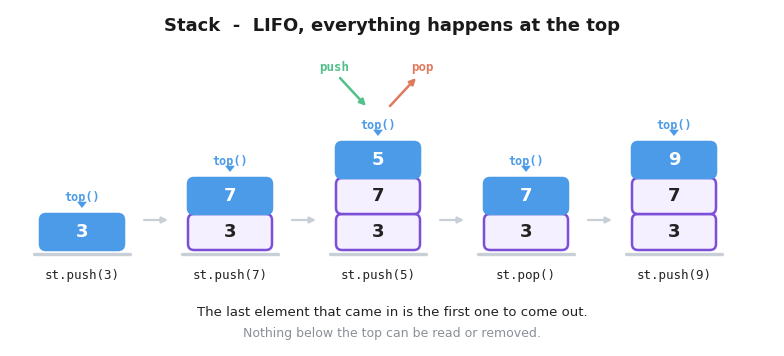
The functions
C++ gives us a ready-made stack, with these operations:
| Function | What it does | Complexity |
|---|---|---|
push(x) |
puts x on top |
O(1) |
pop() |
removes the top element | O(1) |
top() |
returns the top element (without removing it) | O(1) |
empty() |
returns true if the stack is empty |
O(1) |
size() |
returns the number of elements | O(1) |
Everything is O(1) - that is what makes stacks so useful.
Initialization: stack<int> st
Example:
int main(){

    stack<int> st;

    st.push(3);
    st.push(7);
    st.push(5);

    cout<<st.top()<<'\n'; //5 is on top

    st.pop(); //5 leaves

    cout<<st.top()<<'\n'; //now 7 is on top
    cout<<st.size();

    return 0;
}
Output:
5
7
2
Note:
pop()does not return the removed element, and callingtop()orpop()on an empty stack crashes the program. Always checkempty()first when you are not sure!
Note:
A stack is the right tool whenever the most recent thing is the first one we need to deal with. Keep that in mind, it will come up again and again.