Sieve of Eratosthenes
In this lesson we will learn how to find ALL the prime numbers up to n, in almost linear time!
We already know how to check if a single number is prime in O(sqrt(n)).
But what if a problem asks us about primality of many numbers? Checking each one separately gives us O(q * sqrt(n)), which is often too slow.
Whenever we need "is x prime?" answered many times, we want to precompute the answers - just like we did with Prefix Sums.
And to do that we need the Sieve of Eratosthenes.
Theory
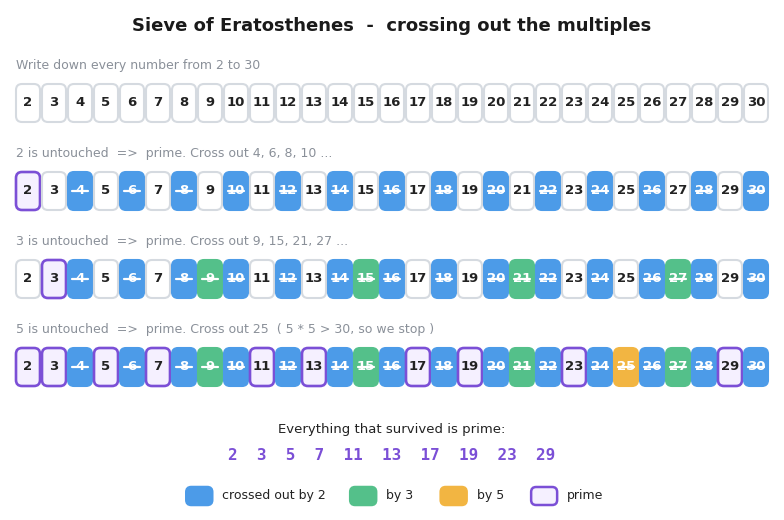
The idea is beautifully simple. Write down all the numbers from 2 to n, then:
- Take the smallest untouched number - it is prime (nothing smaller crossed it out).
- Cross out all of its multiples - they have a divisor, so they are definitely not prime.
- Repeat.
Let's run it for n = 30:
2is untouched => prime. Cross out4, 6, 8, 10...3is untouched => prime. Cross out6, 9, 12, 15...4is crossed out, skip it.5is untouched => prime. Cross out10, 15, 20, 25, 30- ...
Whatever survives the crossing out is a prime: 2 3 5 7 11 13 17 19 23 29
Two optimizations
-
When crossing out multiples of
i, we can start fromi * iinstead of2 * i. Why? Every smaller multiple ofi(like3 * i) has a factor smaller thani, so it was already crossed out by that smaller prime. -
Because of that, the outer loop only needs to run while
i * i <= n- after that point, there is nothing new left to cross out.
Implementation
We represent "crossed out" with a boolean vector:
#include <bits/stdc++.h>

using namespace std;

int main(){

    int n = 30;

    vector<bool> is_prime(n+1, true); //everything starts untouched

    is_prime[0] = false;
    is_prime[1] = false; //remember, 1 is not prime!

    for(int i = 2; i * i <= n; i++){

        if(is_prime[i]){ //i is untouched, so it is prime

            for(int j = i * i; j <= n; j += i){ //cross out the multiples, starting from i*i
                is_prime[j] = false;
            }
        }
    }

    for(int i = 2; i <= n; i++){

        if(is_prime[i]){
            cout<<i<<" ";
        }
    }

    return 0;
}
Output: 2 3 5 7 11 13 17 19 23 29
And from this point on, every "is x prime?" question is a single lookup: is_prime[x] - O(1)!
Complexity
At first glance the two loops look like O(n^2), but count what we actually do: for 2 we cross out n/2 numbers, for 3 we cross out n/3, for 5 only n/5...
n/2 + n/3 + n/5 + n/7 + ...
This sum grows incredibly slowly - the total is O(n log log n), which is nearly indistinguishable from O(n) in practice.
Note:
The sieve has the same weakness as Counting Sort - memory. We need a vector of size n, so this only works for n up to around 10^7. For a single huge number (like 10^18), stick to the O(sqrt(n)) check from the Prime Numbers lesson.