Prime Numbers
In this lesson we will learn what prime numbers are, and how to check if a number is prime!
A number is prime if it is only divisible by 1 and by itself.
The first few primes are: 2, 3, 5, 7, 11, 13, 17...
1is not a prime number!
Lets look at how to check if a number is prime
Brute force check
The simplest way is to try every number from 2 to n-1, and if any of them divides n, the number is not prime.
	bool is_prime = true;

	for(long long i = 2; i < n; i++){
		if(n % i == 0){
			is_prime = false;
		}
	}
This works, but the complexity is O(n). But that is too slow.
We can do much better.
Divisors come in pairs
The key observation: if d divides n, then n / d also divides n.
For example, for n = 36:
1 * 36
2 * 18
3 * 12
4 * 9
6 * 6
Every divisor bigger than 6 is paired up with a divisor smaller than 6. And 6 is exactly sqrt(36).
In other words: if n has any divisor, it has one that is <= sqrt(n)
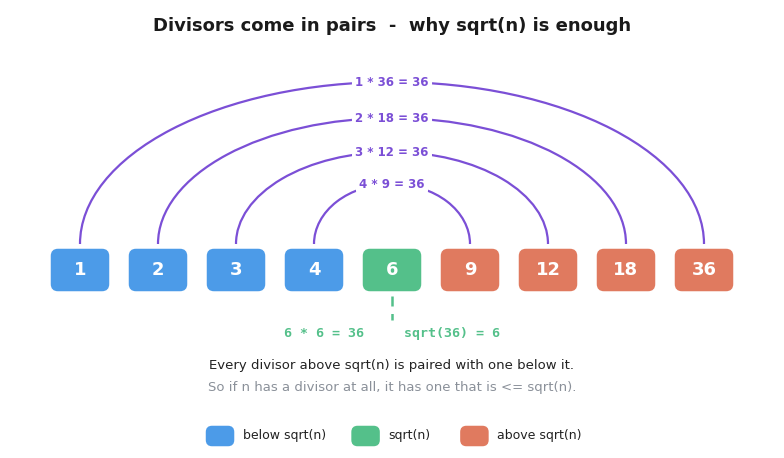
So instead of checking all the way up to n, it is enough to check up to sqrt(n).
Implementation
Instead of writing i <= sqrt(n) (the sqrt function works with decimal numbers, which can cause precision bugs), we write the same condition as i * i <= n:
#include <bits/stdc++.h>

using namespace std;

int main(){

    long long n;
    cin>>n;

    if(n < 2){ //0 and 1 are not prime
        cout<<n<<" is not prime";
        return 0;
    }

    for(long long i = 2; i * i <= n; i++){

        if(n % i == 0){ //we found a divisor, n is not prime

            cout<<n<<" is not prime";
            return 0;
        }
    }

    cout<<n<<" is prime";

    return 0;
}
Input: 97
Output: 97 is prime
Input: 91
Output: 91 is not prime (91 = 7 * 13)
Time complexity: O(sqrt(n))
For n = 10^18, that is around 10^9 operations instead of 10^18 - a massive difference.
Note:
imust be along longas well! Ifiwere anint,i * iwould overflow for largen, and the loop would break!