Counting sort
In this lesson we will learn about a special type of sorting that works in O(n + m) time!
While it is true that this technique is very fast, it only works when we are sorting relatively small non negative values (Numbers <= 10^5 and >= 0)
Let's see why.
Theory
Imagine we have an array:
a = 4, 5, 6, 3, 1, 7, 3
The key idea is to treat each one of these numbers as an index
Lets make a helper array, b, and lets set all the values of b to 0
b[i] will store how many times, each value i has appeard
Then for every value of a, we increase b[a[i]] by one.
i = 0 => a[i] = 4 => b[4] = 0 + 1 = 1
i = 1 => a[i] = 5 => b[5] = 0 + 1 = 1
After doing this for all values b looks like:
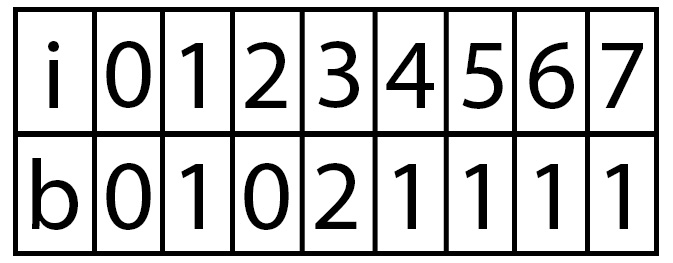
To print the sorted array we just go through b and print i, b[i] times!
Note: duplicate values are also handled, because b[i] stores the number of times an element has appeared
Implementation
#include <bits/stdc++.h>

using namespace std;

int main(){

    vector<int> a = {4, 5, 6, 3, 1, 7,3};

    vector<int> b(100, 0); //we choose a size that we know is larger than the biggest element in a

    for(int i=0;i<a.size();i++){
        b[a[i]]++;
    }

    for(int i =0;i<b.size();i++){

        for(int j=0; j<b[i];j++){ //we print i, b[i] times
            cout<<i<<" ";
        }
    }

    return 0;
 }
The array: 4 5 6 3 1 7 3
Output: 1 3 3 4 5 6 7
Time complexity: O(m + n), where m is the maximum value in a
One thing to note is that if m is too large, we will run into MLE (Memory Limit Exceeded), and our program won't run, that is why m has to be small for this technique to work