Shortest Paths
In this lesson we will learn what a shortest path is, and how to find it
What is a shortest path?
A path from u to v is a sequence of vertices where each one is a neighbour of the next, starting at u and ending at v. Its length is the number of edges on it - not the number of vertices.
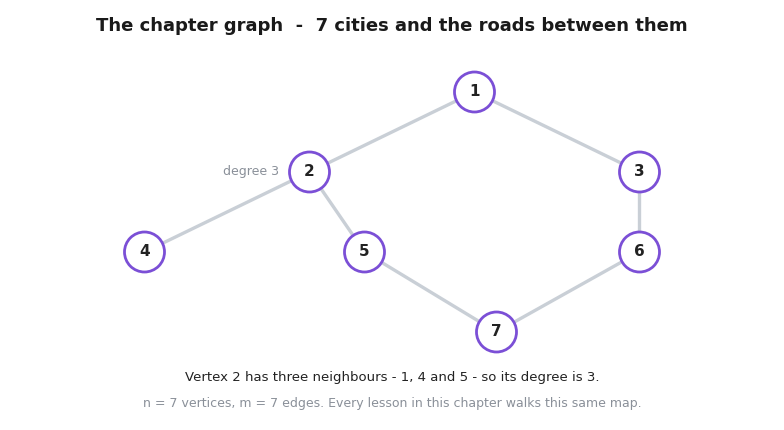
From 1 to 6 our graph offers two of them:
1 3 6- length 21 2 5 7 6- length 4
A shortest path is any path of minimum length, and that minimum is the distance between the two vertices, written d(u, v). So d(1, 6) = 2.
Three things to keep in mind:
- there can be many shortest paths - from
1to7both1 2 5 7and1 3 6 7have length 3. A problem asking for "the" shortest path accepts any of them. - if there is no path at all, the distance is infinite - the two vertices sit in different components
d(v, v) = 0, since staying put costs nothing
Why BFS finds them
Remember how BFS spreads: the start, then everything one edge away, then everything two edges away.
That ordering is the whole proof. When BFS is about to hand out the vertices at distance k + 1, it has already handed out every single vertex at distance k or less. So a vertex that is still unvisited at that moment cannot be closer than k + 1.
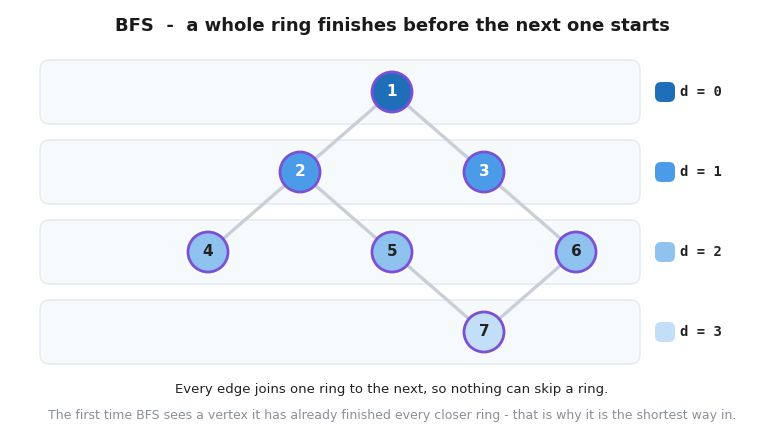
In other words: the first time BFS sees a vertex, it is seeing it along a shortest path. No later route can be better, which is why the visited check never throws away anything useful.
This is also exactly why DFS cannot do it. DFS dives, so the first time it sees a vertex it may have taken a huge detour to get there.
The code
The change is small: visited becomes dist, and -1 means "not reached yet". One array now does both jobs, because a vertex has a distance exactly when it has been visited.
#include <bits/stdc++.h>

using namespace std;

int n = 7;
vector<vector<int>> adj(n+1);
vector<int> dist(n+1, -1); //-1 means "not reached yet"

void addEdge(int u, int v){
    adj[u].push_back(v);
    adj[v].push_back(u);
}

void bfs(int start){

    queue<int> q;

    dist[start] = 0;
    q.push(start);

    while(!q.empty()){

        int v = q.front();
        q.pop();

        for(int i=0;i<adj[v].size();i++){

            int to = adj[v][i];

            if(dist[to] == -1){ //first time we see it, so this is the shortest way in
                dist[to] = dist[v] + 1;
                q.push(to);
            }
        }
    }
}

int main(){

    addEdge(1,2);
    addEdge(1,3);
    addEdge(2,4);
    addEdge(2,5);
    addEdge(3,6);
    addEdge(5,7);
    addEdge(6,7);

    bfs(1);

    for(int v=1;v<=n;v++){
        cout<<v<<": "<<dist[v]<<'\n';
    }

    return 0;
}
Output:
1: 0
2: 1
3: 1
4: 2
5: 2
6: 2
7: 3
One BFS, and we have the distance from 1 to every vertex at once - still O(n + m). Any vertex left holding -1 at the end is simply unreachable.
Reconstructing the path
Distances are often enough, but sometimes a problem wants the route itself. We do not need to store whole paths: when we first reach to from v, we write down that v is the one who let us in.
vector<int> parent(n+1, 0); //parent[v] is the vertex we reached v fromInside the if, one line joins the other two:
            if(dist[to] == -1){
                dist[to] = dist[v] + 1;
                parent[to] = v; //remember who let us in
                q.push(to);
            }
Now walking from 7 back to 1 is just following parent until we fall off the start, which still holds 0. That gives the path backwards, so we reverse it:
    vector<int> path;
    int v = 7;

    while(v != 0){ //walk backwards until we fall off the start
        path.push_back(v);
        v = parent[v];
    }

    reverse(path.begin(), path.end());

    for(int i=0;i<path.size();i++){
        cout<<path[i]<<" ";
    }
Output: 1 2 5 7
Three edges, matching dist[7] = 3. The other shortest path 1 3 6 7 is just as correct - BFS returns the one it happened to find first.
Note:
All of this rests on one assumption: every edge costs the same. BFS counts edges, so the moment a problem gives roads different lengths, the fewest-roads route stops being the shortest route and BFS gives the wrong answer. Weighted graphs need Dijkstra's algorithm instead.