Binary Search
In this lesson we will learn about one of the fastest ways to find if an element is inside of an array - Binary Search
The best way to think about this technique is with a game:
- Imagine any number from 1 to 1000 (let's call it
k), then I get to ask 10 questions, and after those questions I am guaranteed to know your number.
What are the questions?
-
They are: Is k larger than the value in the middle?
So the first question would beis k larger than 500 -
If it is we know that
kis between 500-1000, if its not then we know it is between 1-500
Let's assume that k = 625, so now our range becomes 500-1000
- The second question is:
is k larger than 750
Now the range is from 500-750, and so on...
After the 10 questions, we are guaranteed to know k. But why?
Why?
At the beginning, there are 1000 possible values that k could be
After each question we are halving that number.
If we put them next to each other the possible values are:
1000, 500, 250, 125, 63, 32, 16, 8, 4, 2, 1
So after the 10 questions, we see that there is only one possible value that k could be.
Theory
Binary Search works in the same way.
When solving a problem we have an array a, target number k and n elements
We are going to make log(n) comparisons, and then check if we found k or not.
Note:
Binary Search only works when the array is sorted!
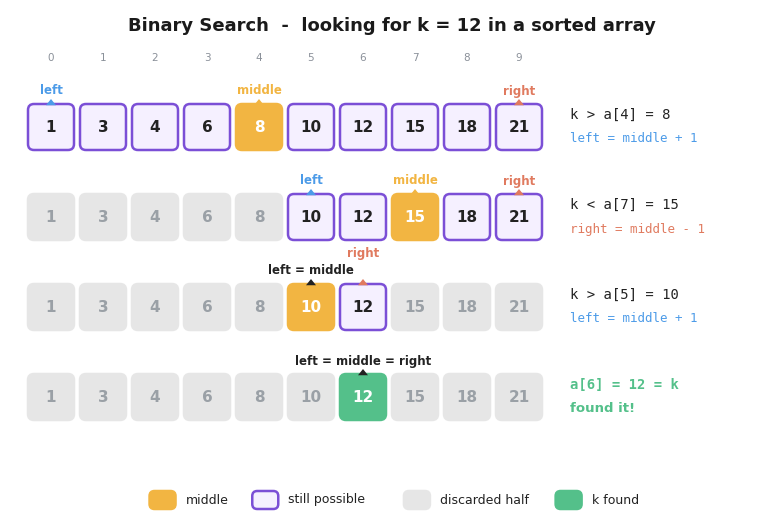
We start with two pointers: left = 0 and right = n-1
Then:
-
we find the middle:
middle = (left + right) / 2 -
we check if:
a[middle] == k
If it is - we have found our solution. If it isn't:
- we check if:
k > a[middle]
If it is, no value smaller than a[middle] can be k, so we can safely move: left = middle + 1
- then we check if:
k < a[middle]
Using the same logic, no value larger than a[middle] can be k, so we move: right = middle - 1
We repeat this process until:
- we find
k - or until the pointers meet:
while(left <= right)
It is important to note that we must also include the case when left == right.
Implementation
Problem: We are given an array a of n elements and are asked q questions. For each question, input one element and check if it exists inside of a
#include <bits/stdc++.h>

using namespace std;

int main(){

    int n;
    cin>>n;

    vector<int> a(n);

    for(int i=0; i< n;i++){
        cin>>a[i];
    }

    sort(a.begin(), a.end()); //we have to sort a!

    int q;
    cin>> q; // The number of questions we are going to ask

    while(q--){ //this loop will run exactly q times.

        int k;
        cin>>k;

        int left = 0;
        int right = n-1;

        bool found_k = false;

        while(left <= right){

            int middle = (left + right) / 2;

            if(a[middle] == k){

                cout<<k<<" is inside of the array!"<<'\n'; // We found our solution
                found_k = true;
                break;

            }else if(k > a[middle]){

                left = middle + 1; // No value smaller than a[middle] can be the solution

            }else if (k < a[middle]){

                right = middle - 1; // No value larger than a[middle] can be the solution
            }
        }

        if(found_k == false){ // we have to check whether we found k,or if the pointers met
            cout<<k<<" is not inside of the array!"<<'\n';
        }

    }

    return 0;
}
Input:
6 - n
10 3 4 6 8 27 - our array
3 - q
10 - first k
45 - second k
2 - third k
Output:
10 is inside of the array!
45 is not inside of the array!
2 is not inside of the array!
Time complexity: O(n log n + q log n) which is just O( (n+q) log n)
Note:
It is faster to do a brute force check when we are checking once O(n) vs having to sort the array for binary search. But when we have to check multiple times, brute force becomes O(n*q), and binary search stays O( (n+q) log n)