Sparse Tables
In this lesson we will learn to solve static range queries without an inverse in O(1), things like min,max,etc...
We already know what static range queries are - a series of [l, r] questions where we need to find something in an array between l and r.
The most common ones are prefix sums, but prefix sums don't work on min and max.
Thats where Sparse Tables come in!
Theory
Before we begin there is one thing to note:
Sparse tables are only useful if the operation we want to use is overlap friendly, in other words if the segment [1, 10] has the same result as [1,6] with [3,10]!
Once we know that is satisfied we can build the table for O(1) queries! (if it's not satisfied, we can just use a segment tree).
And the table is going to be a 2D array where lookup[i][j], will store values from i to 2^j.
We can imagine it as a staircase, where the first layer is the original array, and each layer above goes 1 step more at a time:
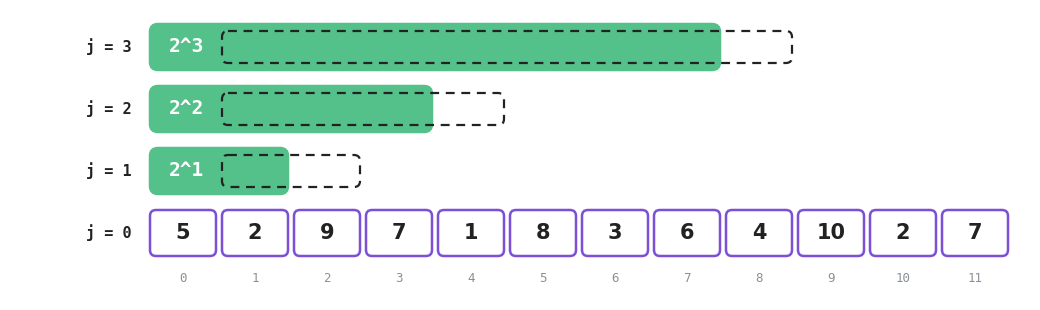
We will use this array of 12 elements for the whole lesson: 5 2 9 7 1 8 3 6 4 10 2 7
The dashed blocks matter as much as the solid ones. Unlike a segment tree, a sparse table has a block starting at every index, not just at the ones that tile neatly. That is why the table is n * log n big, and it is also what makes the query work.
This structure is somewhat similar to segment trees(as in we go in steps of powers of 2)
Building the table
Lets use max as an example
To build the actual table, we will use dynamic programming, starting from the first layer which is just the original array.
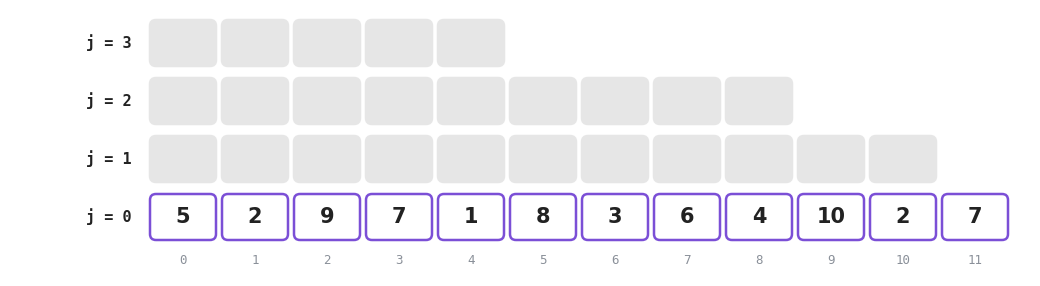
Notice that each layer is shorter than the one below it. A block of 2^j elements starting at i only exists while i + 2^j still fits inside the array, so layer j has n - 2^j + 1 entries.
lookup[i][j] covers the segment [i, i + 2^j - 1]
So each entry is the max of the entry directly below it and the entry 2^(j-1) places to the right of that one:
lookup[i][j] = max(lookup[i][j-1], lookup[i + 2^(j-1)][j-1])
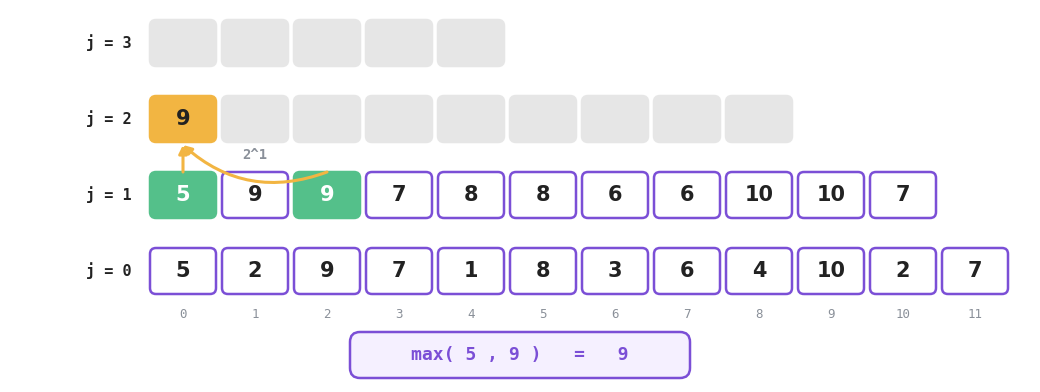
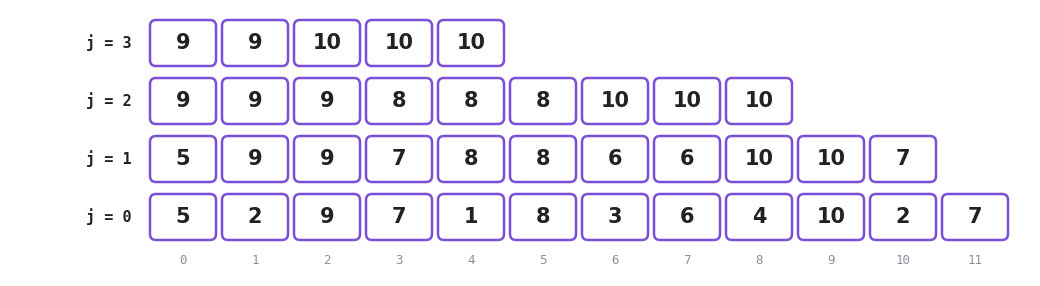
Repeat until the whole table is built:
Querying for a value
This is the part that requires overlap friendliness of the operation used.
We first find highest power of 2 that is smaller than or equal to count of elements in given range. Lets call it k, so the block length is 2^k.
Then two blocks are enough: one glued to the left end of the range, lookup[l][k], and one glued to the right end, lookup[r - 2^k + 1][k]. Because 2^k is more than half the range, the two of them always meet, and usually overlap.
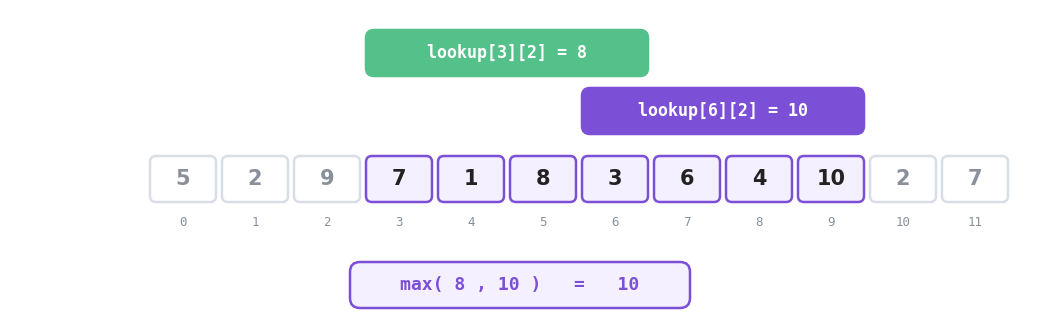
Asking for [3, 9] is 7 elements, so k = 2 and both blocks are 4 long. They cover [3, 6] and [6, 9], overlapping on index 6 - and since max does not care about being told the same thing twice, the answer is simply max(8, 10) = 10.
This is why we get O(1)
Code:
The build has two loops:
The outer loop walks the layers, from 1 upwards. It has to be the outer one, because layer j is built entirely out of layer j-1 - by the time we start a layer, the one below it must already be finished.
The inner loop walks the starting positions inside one layer. It stops at i + 2^j <= n, which is what makes each layer shorter than the last: once the block would run off the end of the array, there is nothing left to store.
Building code:
vector<vector<int>> buildSparseTable(vector<int> &arr) {

    int n = arr.size();

    int levels = 1;

    while((1<<levels) <= n){ //how many doublings still fit inside n
        levels++;
    }

    vector<vector<int>> lookup(n, vector<int>(levels, 0));

    for(int i=0;i<n;i++){ //layer 0 is the array itself
        lookup[i][0] = arr[i];
    }

    for(int j=1;j<levels;j++){ //one layer at a time, each covering twice as much

        for(int i=0; i + (1<<j) <= n; i++){ //every start whose block still fits

            lookup[i][j] = max(lookup[i][j-1], lookup[i + (1<<(j-1))][j-1]);
        }
    }

    return lookup;
}
The query has one loop, and it is only there to find k. It counts how many times we can double before passing the length of the range, which is at most log n steps and happens once per query.
Query code:
long long power_of_two(long long a){ //the largest k with 2^k <= a

    long long k = 0;

    while((1LL<<(k+1)) <= a){
        k++;
    }

    return k;
}

int query(int L, int R, vector<vector<int>> &lookup)  {

    int len = R - L + 1;

    int k = power_of_two(len); //both blocks we read are 2^k long

    return max(lookup[L][k], lookup[R - (1<<k) + 1][k]);
}
Putting it together on our array:
int main(){

    vector<int> arr = {5, 2, 9, 7, 1, 8, 3, 6, 4, 10, 2, 7};

    vector<vector<int>> lookup = buildSparseTable(arr);

    cout<<query(3, 9, lookup)<<'\n';
    cout<<query(0, 4, lookup)<<'\n';
    cout<<query(6, 8, lookup)<<'\n';

    return 0;
}
Output:
10
9
6
Building fills n * log n entries and each one costs a single comparison, while a query reads exactly two of them no matter how wide the range is.
Build: O(n log n)
Query: O(1)
Memory: O(n log n)
Note:
Sparse tables are built once and never change. There is no update operation - the moment an element can change, the whole table below it is wrong, and you want a segment tree instead.