Radix Sort
In this lesson we will learn about an improved version of Counting Sort
Last lesson we learned Counting Sort, which is very fast, but breaks down when the values are large (larger than 10^5).
Radix Sort fixes exactly that. The values can be as big as we want, because we never treat the whole number as an index - only one digit at a time.
Since a digit is always between 0 and 9, we can use Counting Sort!
Theory
The idea is to sort the array multiple times, once for each digit:
- Sort all the numbers by their ones digit
- Then sort them by their tens digit
- Then by the hundreds digit, and so on...
We repeat this until we run out of digits (the number of digits of the largest element).
The only rule we must follow: when two numbers have the same digit, they must keep the order they were in (this is called a stable sort).
Example: a = 170, 45, 75, 90, 802, 24, 2, 66
| Pass | Sorting by | Array after the pass |
|---|---|---|
| 1 | ones | 170, 90, 802, 2, 24, 45, 75, 66 |
| 2 | tens | 802, 2, 24, 45, 66, 170, 75, 90 |
| 3 | hundreds | 2, 24, 45, 66, 75, 90, 170, 802 |
When comparing numbers with different amounts of digits, we can simply add leading zeros to the smaller number: (ex. 2 and 802, we can write 002)
Check the second pass: 802 and 2 both have 0 in the tens place, so they come first, and they stayed in the same order as after pass 1.
Sorting by one digit
In order to sort the array digit by digit, we use buckets
We make 10 buckets, one for each digit 0-9. Then:
- we go through the array, and drop each number into the bucket of its current digit
So when sorting by the ones digit, 45 goes into bucket 5, and 170 goes into bucket 0.
- then we go through the buckets in order, from
0to9, and put the numbers back into the array
Numbers from a smaller bucket come first, so the array is now sorted by that digit. And since the buckets are filled from left to right, and emptied from left to right, numbers with the same digit keep their order - this keeps the order stable
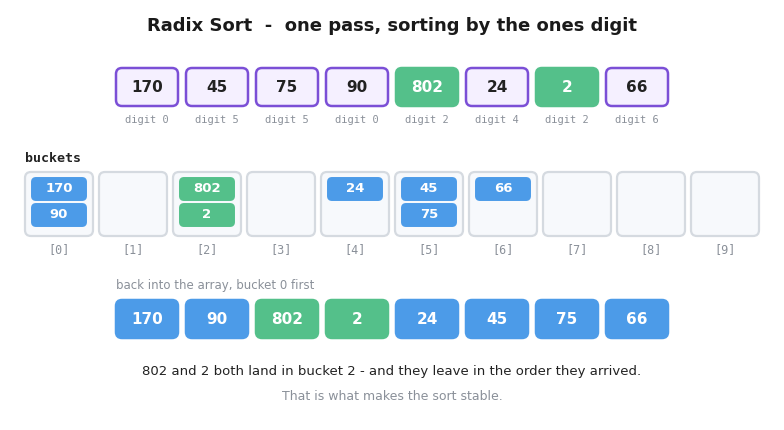
To extract the digit, we use a helper variable place, which is 1 for ones, 10 for tens, 100 for hundreds...
digit = (a[i] / place) % 10
- dividing by
placecuts off everything to the right of our digit % 10cuts off everything to the left of it
For example, for 802 when sorting by tens: 802 / 10 = 80, then 80 % 10 = 0 - the tens digit is 0.
We keep going until we run out of digits in the maximum element, aka while mx / place > 0
Code
#include <bits/stdc++.h>

using namespace std;

int main(){

    vector<int> a = {170, 45, 75, 90, 802, 24, 2, 66};

    int mx = a[0]; // mx will store the maximum element

    for(int i=0;i<a.size();i++){
	    mx = max(mx,a[i]);
    }

    for(long long place = 1; mx / place > 0; place *= 10){ //place is 1, 10, 100...

        vector<vector<int>> buckets(10); //one bucket for each digit 0-9

        for(int i=0;i<a.size();i++){

            int digit = (a[i] / place) % 10; //the digit at the current place
            buckets[digit].push_back(a[i]);
        }

        int idx = 0;

        for(int d=0;d<10;d++){ //put the elements back, bucket by bucket

            for(int i=0;i<buckets[d].size();i++){
                a[idx] = buckets[d][i];
                idx++;
            }
        }
    }

    for(int i=0;i<a.size();i++){
        cout<<a[i]<<" ";
    }

    return 0;
}
The array: 170 45 75 90 802 24 2 66
Output: 2 24 45 66 75 90 170 802
Time complexity: O(d * n), where d is the number of digits of the largest element
Note:
While radix sort can be really fast, it's also very situational, it can only be used for numbers, and more importantly when numbers are largedcan exceedlog n.