GCD and LCM
In this lesson we will learn how to compute the greatest common divisor and least common multiple of two numbers - in logarithmic time!
Two definitions first:
- GCD (Greatest Common Divisor) of
aandbis the largest number that divides both of them. - LCM (Least Common Multiple) of
aandbis the smallest number that is divisible by both of them.
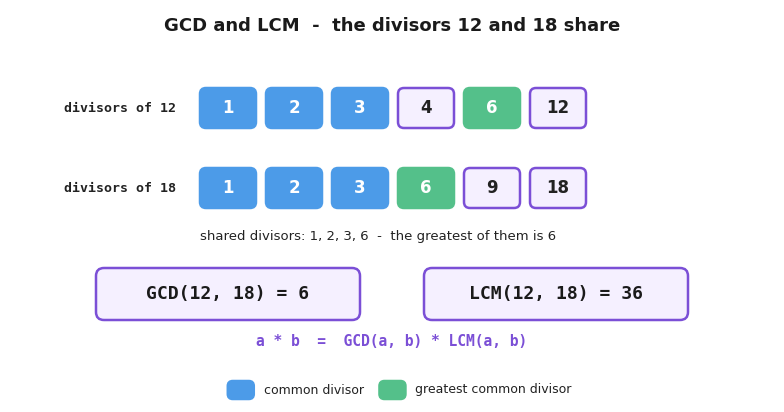
Example: for a = 12 and b = 18:
- Divisors of
12:1, 2, 3, 4, 6, 12 - Divisors of
18:1, 2, 3, 6, 9, 18
The biggest shared one is 6, so GCD(12, 18) = 6. And the smallest number both divide into is 36, so LCM(12, 18) = 36.
Comparing lists of divisors works, but finding them takes O(sqrt(n)). There is a much more elegant way, discovered over 2000 years ago.
The Euclidean Algorithm
The whole algorithm is one observation:
GCD(a, b) = GCD(b, a % b)
Any number that divides both a and b also divides a % b (the remainder is just a minus b a couple of times). So the pair (b, a % b) has exactly the same common divisors as (a, b) - including the greatest one.
We repeat this until b becomes 0, and then the answer is simply a (every number divides 0, so GCD(a, 0) = a).
Let's look at GCD(12, 18):
| step | a | b | a % b |
|---|---|---|---|
| 1 | 12 | 18 | 12 |
| 2 | 18 | 12 | 6 |
| 3 | 12 | 6 | 0 |
| 4 | 6 | 0 | - |
b reached 0, so GCD(12, 18) = 6.
(Notice how the first step just swapped the numbers - the algorithm fixes the order by itself!)
What about LCM?
LCM is very simple, thanks to this formula:
So:
Implementation
When we are implementing LCM, we want to write it as , this is exactly the same as the formula above but it doesn't risk overflow
#include <bits/stdc++.h>

using namespace std;

long long gcd(long long a, long long b){

    while(b != 0){

        long long r = a % b;
        a = b;
        b = r;
    }

    return a;
}

long long lcm(long long a, long long b){

	return a / gcd(a,b) * b; // We divide first, then multiply

}

int main(){

    long long a = 12;
    long long b = 18;

    long long g = gcd(a, b);
    long long l = lcm(a,b);

    cout<<"GCD: "<<g<<'\n';
    cout<<"LCM: "<<l;

    return 0;
}
Output:
GCD: 6
LCM: 36
Time complexity: O(log(min(a, b)))
It can be proven that the numbers shrink at least by half every two steps, which is where the logarithm comes from.
Note:
C++ already has this built in:__gcd(a, b)works out of the box, and since C++17 there are alsogcd(a, b)andlcm(a, b). Feel free to use them, but do note that some judges may not accept C++ 17