Matrices
In this lecture we will talk about matrices - or vectors of vectors
Theory
Matrices are 2D arrays, we can think of them as grids, where each field stores a value.
A matrix is labeled AxB, depending on its size, where A and B are numbers
So a 3x3 matrix would look like:
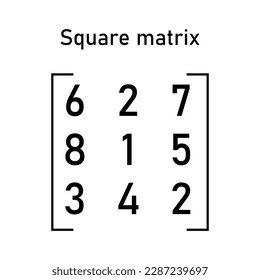
It is comprised of rows and columns.
If we look at the example the rows they are: [6, 2, 7], [8, 1, 5], [3, 4, 2]
We can also look at the columns and they are: [6, 8, 3], [2, 1, 4], [7, 5, 2]
Implementation
A matrix with n rows and m columns is written like : vector<vector<data_type>> name_of_the_matrix(n, vector<data_type>(m, default_value));
Lets unpack this:
vector<vector<data_type>>- is how we declare the matrixname_of_the_matrix- is the name of the matrixn- is the number of rows our matrix will havevector<data_type>(m, default_value)- is what each row will look like - a vector withmelements (one for each column)
We can also access the element in row i and column j with: a[i][j]
Just like vectors, matrices are 0 indexed by default, this means that the value in the second row and third column is in a[1][2]
Example code which shows the i and j values of each field:
#include <bits/stdc++.h>

using namespace std;

int main(){

    cin.tie(0);
    ios_base::sync_with_stdio(false);

    int n = 3;
    int m = 4;

    vector<vector<string>> a(n, vector<string>(m)); //We initialize the matrix

    for(int i=0;i<n;i++){ //this means for each row
        for(int j=0;j<m;j++){ //this means for each column in the row

            a[i][j] = "(" + to_string(i) + ", " + to_string(j) + ")"; //to_string turns our counter which is an integer into a string, the rest is just formatting

        }
    }

    for(int i=0;i<n;i++){
        for(int j=0;j<m;j++){
            cout<<a[i][j]<<" ";
        }
        cout<<'\n'; // new line character(like enter)
    }

    return 0;
}
Output:
(0, 0) (0, 1) (0, 2) (0, 3)
(1, 0) (1, 1) (1, 2) (1, 3)
(2, 0) (2, 1) (2, 2) (2, 3)