Geometry Basics
In this lesson we will learn the basics about geometry in computer science. (also everything will be in 2D, which is nice)
Before we begin, lets remind ourselves of a basic theorem we should already know:
Pythagorean Theorem
If we have a right triangle, with sides a, b and c. Where c is the longest side (also known as the hypothenuse ), it can be gotten by the formula:
Representing points and lines
Almost every geometry problem we get will be from the field of Analytic geometry, so let's familiarize ourselves with it.
Everything we get will be represented as points (a pair of two coordinates).
In code, they can be stored as either a pair<int,int> point
Or a struct:
struct point{
	long long x;
	long long y;
};

int main(){
	point a;
	a.x = 1;
	a.y = 2;
}
Another thing we should know is how to represent a line (a pair of two points):
struct line{
	point x;
	point y;
};
The distance between two points
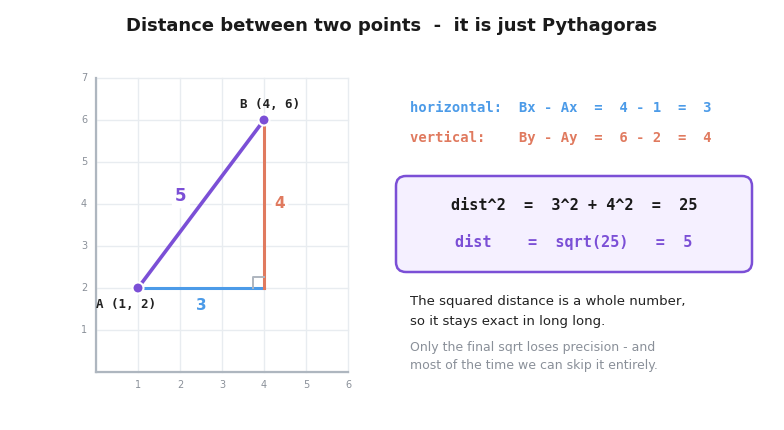
The distance between two points(A and B) can be derived directly from the Pythagorean Theorem.
Imagine a triangle between the points, where the distance between them is the hypothenuse dist.
Their horizontal distance is now
And vertical distance is
To get dist we use:
Notice that we don't need the absolute value, since we are squaring both terms!
Implementation
#include <bits/stdc++.h>

using namespace std;

struct point{

    long long x, y;
};

long long dist2(point a, point b){ // squared distance - stays an integer!

    long long dx = a.x - b.x;
    long long dy = a.y - b.y;

    return dx * dx + dy * dy;
}

double dist(point a, point b){

    return sqrt((double)dist2(a, b));
}

int main(){

    point a = {1, 2};
    point b = {4, 6};

    cout<<"Squared distance: "<<dist2(a, b)<<'\n';
    cout<<"Distance: "<<dist(a, b);

    return 0;
}
Output:
Squared distance: 25
Distance: 5
Notice two things: the coordinates are long long and not int, and we wrote a separate dist2 function that never touches sqrt. Both of those choices are on purpose, and the next section explains why.
A word about precision
This is the part where most geometry solutions die, so read it carefully.
1. Stay in integers for as long as you can.
If the input coordinates are whole numbers, then differences, sums and products of them are also whole numbers. Every calculation done in long long is exact. The moment we call sqrt we lose that.
2. Watch out for overflow.
Coordinates in problems often go up to .. Squaring that gives , which barely fits into long long (the limit is about ). This is why we used long long above - int coordinates are a classic trap.
3. Avoid sqrt when you can.
Very often we do not need the actual distance, only a comparison: which point is closer, is this distance bigger than that one, are these two distances equal. Since distances are never negative, we have:
So we can compare dist2 instead of dist and keep everything exact and fast. The same trick works for "is the distance at most r": compare instead of .
Tip:
If the answer needs to be printed as a real number, control the output yourself withcout<<fixed<<setprecision(6)<<ans;- otherwisecoutprints only 6 significant digits and large answers get mangled.
Summary
| Thing | Formula | Note |
|---|---|---|
| Point | a place | |
| Line | two points | |
Distance A to B |
compare squared when possible |
That is everything we need to describe where things are. In the next lesson we learn how to describe movement between them - vectors.