Fenwick Trees
In this lesson we will learn about a faster, but more limited, version of segment trees - Fenwick Trees (aka. Binary Indexed Trees, aka. BIT)
Just like Segment Trees, Fenwick trees answer dynamic range queries.
But there are a few main differences:
- Fenwick Trees are faster by a constant factor (aka. They are still O( n), but the constants are smaller)
- Fenwick Trees take up less memory (O(n) memory)
- Fenwick Trees are simpler to implement (but harder to understand)
- Fenwick Trees are more limited (Everything a Fenwick tree can solve, a Segment tree can as well, but not the other way)
Main limitation
Due to how they work (we will get to that in a moment), fenwick trees require the operation they are implementing to have an inverse.
Operation that have inverses are: addition(it's inverse is subtraction), subtraction (it's inverse is addition), multiplication (it's inverse is division)...
Operations that don't have inverses are: min, max, and...
Using the Tree
Getting a mental image of fenwick trees is rather difficult, so lets start from the explanation:
The tree will be stored as an array of size n.
On position k, will be the sum of the interval [f(k)+1,k]
And f(k) is the number you get by removing the first bit from the right (The "least significant bit").
This might seem odd, but think of it as a "fancy" prefix sum.
If we look at the array a = {1, 2, 5, 3, -2, 8, -3}, a Fenwick representation looks like this:
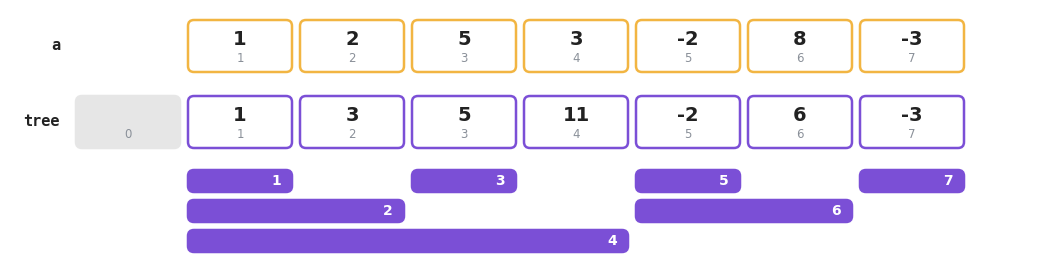
As you can see, we have a series of segments that cover each position.
The key observation we can make is that by summing the segments
Until f(k) becomes 0, we actually get:
Every step removes one set bit from k, and k has at most of them, so it takes steps to get the full sum!
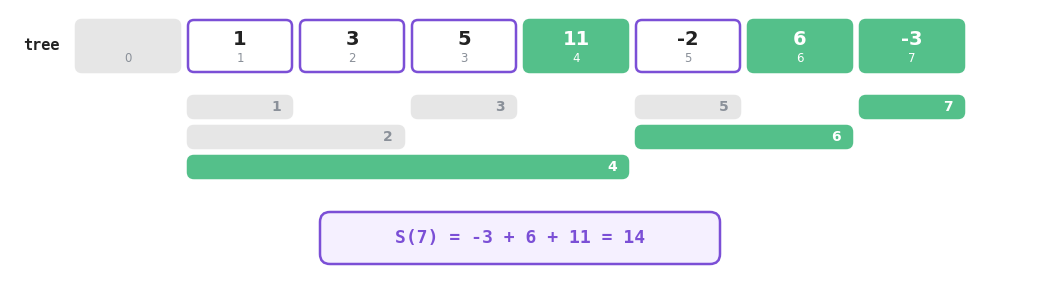
And to get the sum from , we simply run
Note:
Fenwick trees are always 1-indexed! Position 0 has no least significant bit, so every loop would get stuck on it.
Updating elements
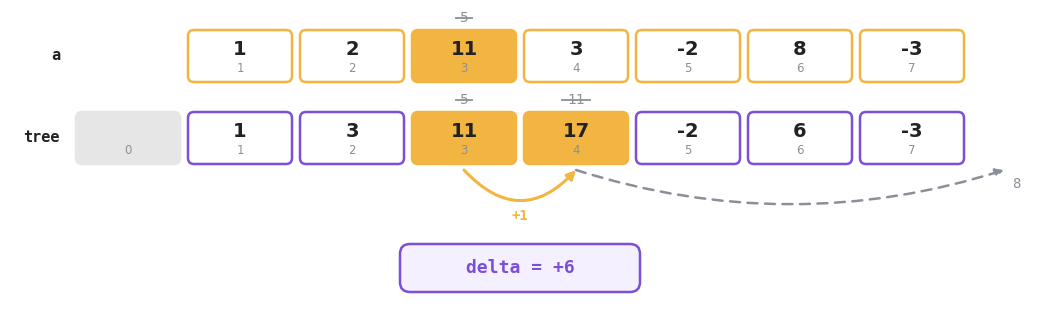
Let's say we wanted to change 5 to 11 in our array a = {1, 2, 5, 3, -2, 8, -3}
We would first calculate delta, which means by how much has our value changed: delta = y - x => 11 - 5 => +6.
Now we need to walk through all affected positions(lets call these positions parents), and add delta to them! (this is why Fenwick trees need an inverse)
We do so by a new "least significant bit" until the end of the array:
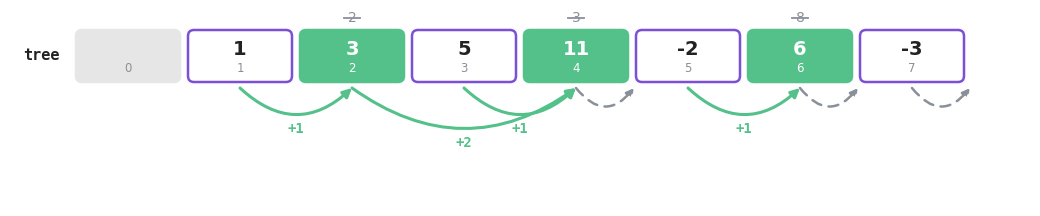
Creating the Tree:
First we copy the original elements, and place a 0 on the first position:
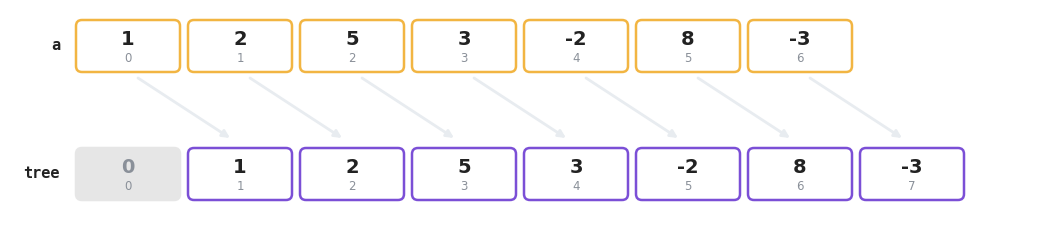
Then, we go through each position, and add the current value to the parent's:
Implementation
Getting f(k) is done with: f(k) = k - (k & -k)
Lets see with 0101 (5):
-5 is 1011 in binary, so 0101 & 1011 = 0001
f(5) = 5 - 1 = 4
Getting a parent is just as easy, except we add the bit instead of removing it:
parent(k) = k + (k & -k)
Code:
Creating the tree:
//assuming elements is a 0-indexed array
void createFenwick(vector<int>& a, const vector<int>& elements) {

    int n = elements.size();
    a.assign(n + 1, 0); //This function places changes the size of a, and then places zeros on every position

    // Step 1: copy elements
    for (int i = 1; i <= n; i++) {
        a[i] = elements[i - 1];
    }

    // Step 2: build Fenwick structure
    for (int i = 1; i <= n; i++) {
        int parent = i + (i & -i);
        if (parent <= n) {
            a[parent] += a[i];
        }
    }
}
Getting the Sum:
int prefixSum(vector<int>& a, int k) {
	int sum = 0;

	while(k>0){
		sum += a[k];
		k -= k & -k;
	}
	return sum;
}
Adding an element. Watch out, pos is 1-indexed here, just like the whole tree:
//Puts element el, on index pos
void add(vector<int>& a, vector<int>& elements,int pos, int el){

	int n = a.size();

	int delta = el - elements[pos-1]; //by how much the value changed
	elements[pos-1] = el;

	while(pos < n){
		a[pos] += delta;
		pos += pos & -pos;
	}
}
Time complexity: O(n) - for creation. O(log n) per query and update
Memory: O(n)
Note:
Notice that we have to keep the originalelementsarray next to the tree. The tree only stores segment sums, so we cannot read an element's old value out of it - and we need that old value to computedelta.
As we can see, Fenwick trees are much faster to implement than Segment Trees.