Circles
In this lesson we close the chapter with the one shape that is not made of straight pieces.
A circle has no corners to take orientations of, so none of the cross product machinery transfers. What replaces it is simpler: a circle is just every point at distance r from the centre, and we have been measuring distance since the first lesson.
A point and a circle
Keep r exactly as it came in and reach for r * r in every comparison - the same rule as dist2, for the same reason. Both sides are non-negative, so squaring changes nothing except keeping us in whole numbers:
dist2(C, P) < r * r=> insidedist2(C, P) == r * r=> exactly on the circledist2(C, P) > r * r=> outside
#include <bits/stdc++.h>

using namespace std;

struct v{

    long long x, y;
};

struct circle{

    v c;
    long long r;
};

v sub(v a, v b){

    return {a.x - b.x, a.y - b.y};
}

long long dot(v a, v b){

    return (a.x * b.x) + (a.y * b.y);
}

long long cross(v a, v b){

    return (a.x * b.y) - (a.y * b.x);
}

long long dist2(v a, v b){

    return dot(sub(a, b), sub(a, b));
}

int pointVsCircle(circle k, v p){ // 1 inside, 0 on the circle, -1 outside

    long long d2 = dist2(k.c, p);
    long long r2 = k.r * k.r;

    if(d2 < r2){
        return 1;
    }

    if(d2 == r2){
        return 0;
    }

    return -1;
}

int main(){

    circle k = {{0, 0}, 5};

    cout<<pointVsCircle(k, {3, 3})<<'\n'; //inside
    cout<<pointVsCircle(k, {3, 4})<<'\n'; //exactly on it
    cout<<pointVsCircle(k, {5, 5})<<'\n'; //outside

    return 0;
}
Output:
1
0
-1
Every value here is a whole number, so "exactly on the circle" is a question we can actually answer. It is the last time in this lesson that things are this comfortable.
Every snippet from here on assumes these functions are already written above it.
A line and a circle
One number decides everything: the perpendicular distance d from the centre to the line.
| Points | |
|---|---|
d > r |
0, the line misses |
d = r |
1, a tangent |
d < r |
2 |
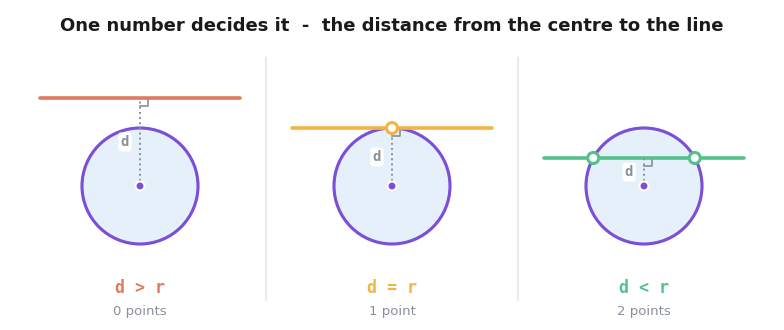
The previous lesson gives us d, and we only want to compare it with r, so we square both sides and the count stays in integers:
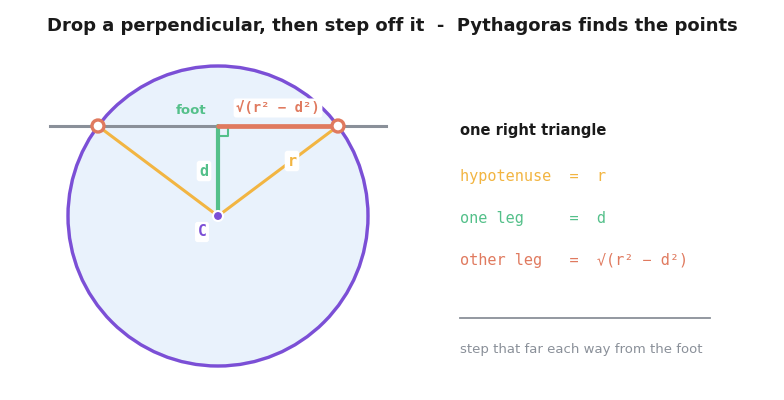
For the points themselves there is no avoiding real numbers, but the construction is short:
- Drop a perpendicular from the centre onto the line. Where it lands is the foot - the shadow from the previous lesson puts it at with .
- The foot, the centre and one intersection point make a right triangle with hypotenuse
rand one legd, so the third side is . - Step that far off the foot in both directions and you land on both points.
struct point{

    double x, y;
};

int lineCircle(circle k, v a, v b, vector<point> &out){ //returns how many points

    v ab = sub(b, a);
    v ac = sub(k.c, a);

    long long ab2 = dot(ab, ab);
    long long cr = cross(ab, ac);

    long long lhs = cr * cr; //squared distance to the line, times ab2
    long long rhs = k.r * k.r * ab2;

    out.clear();

    if(lhs > rhs){ //the line misses the circle
        return 0;
    }

    double t = (double)dot(ab, ac) / ab2; //the foot of the perpendicular
    point foot = {a.x + t * ab.x, a.y + t * ab.y};

    if(lhs == rhs){ //tangent, the foot is the single point
        out.push_back(foot);
        return 1;
    }

    double d2 = (double)lhs / ab2; //the real squared distance
    double step = sqrt(((double)k.r * k.r - d2) / ab2); //how far to walk, in units of ab

    out.push_back({foot.x - step * ab.x, foot.y - step * ab.y});
    out.push_back({foot.x + step * ab.x, foot.y + step * ab.y});

    return 2;
}

void print(vector<point> p){

    for(int i = 0; i < p.size(); i++){
        cout<<" ("<<p[i].x<<", "<<p[i].y<<")";
    }

    cout<<'\n';
}

int main(){

    cout<<fixed<<setprecision(2);

    circle k = {{0, 0}, 5};
    vector<point> p;

    cout<<lineCircle(k, {-10, 3}, {10, 3}, p); print(p); //cuts through
    cout<<lineCircle(k, {-10, 5}, {10, 5}, p); print(p); //tangent at the top
    cout<<lineCircle(k, {-10, 7}, {10, 7}, p); print(p); //misses

    return 0;
}
Output:
2 (-4.00, 3.00) (4.00, 3.00)
1 (0.00, 5.00)
0
This is about the line through A and B, not the segment. For a segment, find the points first and then check each one with the shadow test from the previous lesson.
Two circles
Again one number decides it: the distance d between the two centres, weighed against the two radii. Slide the circles apart in your head and every case shows up in order:
| Case | Points |
|---|---|
| 0, too far apart | |
| 1, touching from outside | |
| 2 | |
| 1, touching from inside | |
| 0, one is inside the other | |
| and | the same circle, infinitely many |
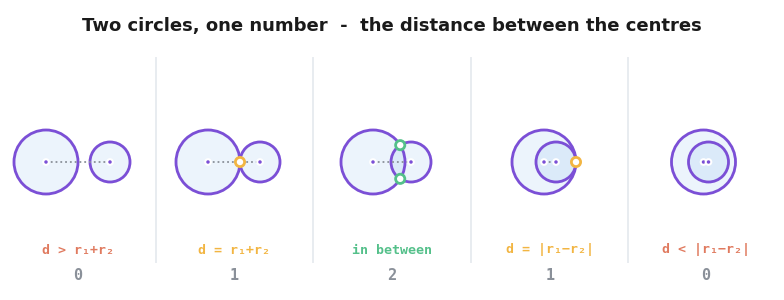
Squaring gets the whole table back into integers - compare with and , and the absolute value disappears on its own.
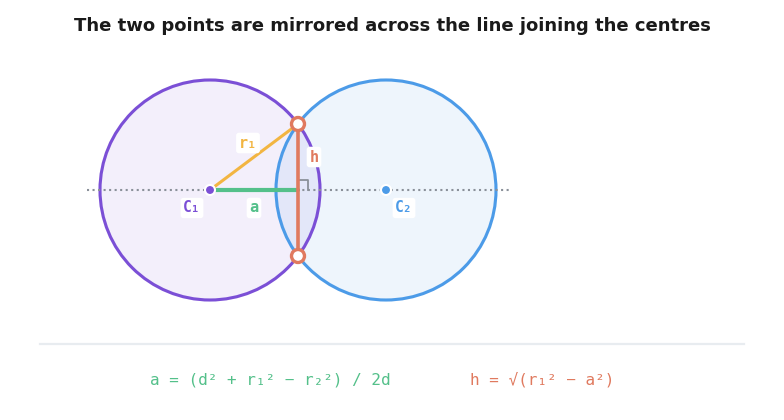
The construction mirrors the line case. The two points are symmetric about the line joining the centres, which they cross at distance from , and Pythagoras gives the perpendicular step . To step perpendicular to we use - the same vector turned a quarter turn.
int circleCircle(circle k1, circle k2, vector<point> &out){ //-1 means the same circle

    v dc = sub(k2.c, k1.c);
    long long d2 = dot(dc, dc);

    out.clear();

    if(d2 == 0){ //same centre - either the same circle or nothing
        return (k1.r == k2.r) ? -1 : 0;
    }

    long long sum = (k1.r + k2.r) * (k1.r + k2.r);
    long long dif = (k1.r - k2.r) * (k1.r - k2.r);

    if(d2 > sum || d2 < dif){
        return 0;
    }

    double d = sqrt((double)d2);
    double a = ((double)d2 + (double)k1.r * k1.r - (double)k2.r * k2.r) / (2 * d);

    point base = {k1.c.x + a * dc.x / d, k1.c.y + a * dc.y / d};

    if(d2 == sum || d2 == dif){ //tangent, from outside or from inside
        out.push_back(base);
        return 1;
    }

    double h = sqrt((double)k1.r * k1.r - a * a);
    point step = {-h * dc.y / d, h * dc.x / d}; //perpendicular to the line of centres

    out.push_back({base.x - step.x, base.y - step.y});
    out.push_back({base.x + step.x, base.y + step.y});

    return 2;
}

int main(){

    cout<<fixed<<setprecision(2);

    circle k = {{0, 0}, 5};
    vector<point> p;

    cout<<circleCircle(k, {{8, 0}, 5}, p); print(p); //overlapping
    cout<<circleCircle(k, {{10, 0}, 5}, p); print(p); //touching from outside
    cout<<circleCircle(k, {{20, 0}, 5}, p); print(p); //too far apart
    cout<<circleCircle(k, {{1, 0}, 1}, p); print(p); //the small one is inside
    cout<<circleCircle(k, {{0, 0}, 5}, p); print(p); //the same circle

    return 0;
}
Output:
2 (4.00, -3.00) (4.00, 3.00)
1 (5.00, 0.00)
0
0
-1
The fourth line deserves a second look. Zero points, and yet the small circle sits comfortably inside the big one - the count says nothing about containment, which is a separate test: .
The trap: tangency
Every table in this lesson has a middle row where two things are exactly equal, and those rows are the ones that break solutions.
With integer input we are fine - lhs == rhs and d2 == sum compare whole numbers. But once a circle comes out of a computation instead of the input, a tangency that should land on d == r arrives off, and the answer silently becomes 0 or 2 points instead of 1.
So when doubles are unavoidable, compare with a tolerance:
const double EPS = 1e-9;

if(abs(d - r) < EPS){ //treat it as a tangent
    ...
}
EPS is a tolerance, not a magic number. 1e-9 is reasonable around 1 and hopelessly tight around , where a double has already lost those digits. It also changes the answer: circles that miss by are now reported as touching. Usually that is what a problem wants - but it is a decision either way.
Note:
With integer input, do not introduce doubles just to compare. Every counting question here is exact inlong long; only the point coordinates need asqrt. Watchcr * crinlineCirclethough -cralone reaches , so the exact test only holds up to coordinates of roughly .
And that closes the chapter. Orientation, segment crossings, polygon area, the hull, and now circles all came out of two operations on vectors. Learn the dot and cross product properly and the rest is bookkeeping.