Divide and Conquer
In this lesson we will learn about a technique behind efficient Sorting - Divide and Conquer
The core of this technique is to split a large job, that takes a lot of time(lets say ), into jobs that take a lot less time.
We do that by splitting an array into half, repeatedly, until we have just one element left in each section.
The question is now, can we merge these sections efficiently?
Lets look at an example to get a feel for it:
Merge Sort
This is the most efficient sorting algorithm, and it works using divide and conquer.
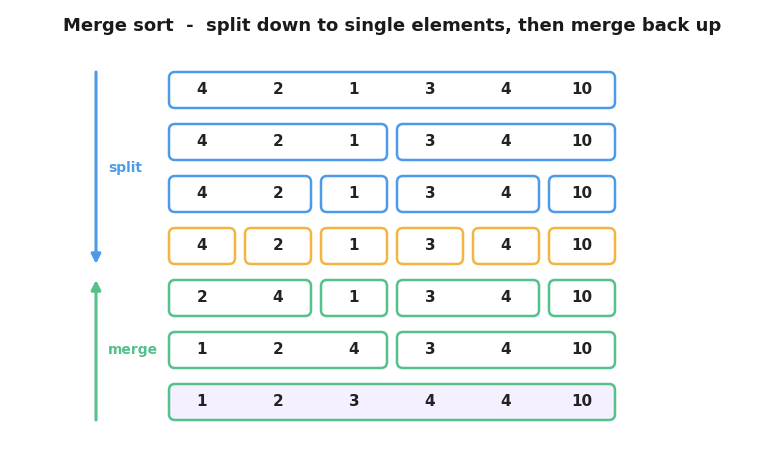
Lets start with an array a = {4, 2, 1, 3, 4, 10}
We first split it into sections: {4}, {2}, {1}, {3}, {4}, {10}
Now how do we merge these sections?
Remember the problem Merge Two Sorted Arrays, this is exactly that. Compare each two sections, and do a merge with two pointers.
Our sections become: {2, 4}, {1, 3}, {4, 10}
Then: {1, 2, 3, 4}, {4, 10}
And finally: {1, 2, 3, 4, 4, 10}
Implementation
The simplest way to implement any divide and conquer solution is with recursion (although as with any recursive algorithm, it can be implemented iteratively):
#include <iostream>
#include <vector>
using namespace std;

void merge(vector<int>& arr, int left, int mid, int right){ // Helper function for merging two parts of the array

    int n1 = mid - left + 1;
    int n2 = right - mid;

    vector<int> L(n1), R(n2); //Create temporatry arrays

	//Copy the data
    for (int i = 0; i < n1; i++){
        L[i] = arr[left + i];
    }
    for (int j = 0; j < n2; j++){
        R[j] = arr[mid + 1 + j];
	}

    int i = 0, j = 0;
    int k = left;

	//Do a standard merge
    while (i < n1 && j < n2) {
        if (L[i] <= R[j]) {
            arr[k] = L[i];
            i++;
        }
        else {
            arr[k] = R[j];
            j++;
        }
        k++;
    }

    // Copy the remaining elements of L, if there are any
    while (i < n1) {
        arr[k] = L[i];
        i++;
        k++;
    }

    // Copy the remaining elements of R[], if there are any
    while (j < n2) {
        arr[k] = R[j];
        j++;
        k++;
    }
}

void mergeSort(vector<int>& arr, int left, int right){ // The main recursive func

    if (left >= right)
        return;

    int mid = left + (right - left) / 2; //We split the array into halves

    mergeSort(arr, left, mid); // The left half
    mergeSort(arr, mid + 1, right); // The right half

    merge(arr, left, mid, right); //We merge the halfs
}

int main(){

    vector<int> arr = {4, 2, 1, 3, 4, 10};
    int n = arr.size();

    mergeSort(arr, 0, n - 1);

    for (int i = 0; i < arr.size(); i++){
	    cout << arr[i] << " ";
    }

    return 0;
}
Output:
1 2 3 4 4 10
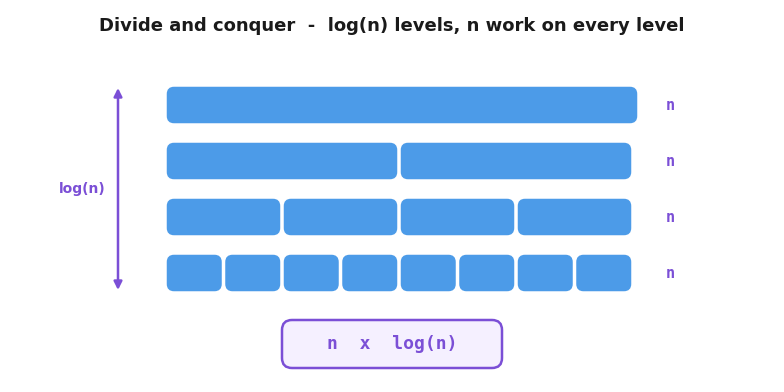
We half the array O(log n) times, and merging the halves costs us O(n)
Time Complexity: