Distances and Intersection Points
In this lesson we stop asking yes or no questions and start asking for numbers - how far, and where exactly.
Everything so far has been a sign: which side, do they cross, is it inside. That is why all of it stayed in whole numbers, and all of it was exact.
Distances and crossing points are measurements, and measurements come out as fractions. This is where we finally leave the integers
The shadow
So far the dot product had one job: telling us when two vectors are perpendicular. That was underselling it.
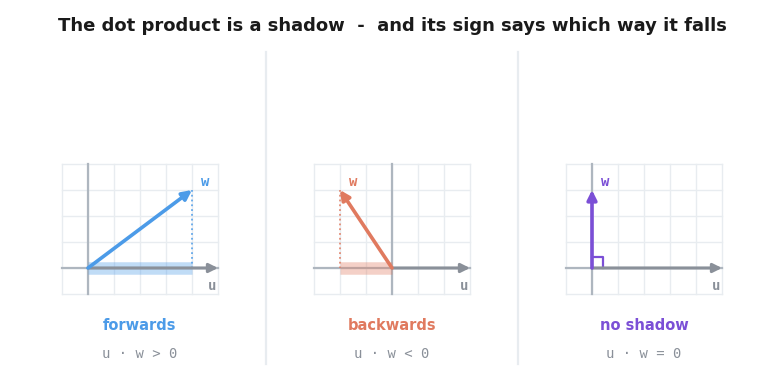
Shine a light straight down onto and hold above it. The shadow that casts on is called its projection, and it starts at the start of .
The sign of the dot product alone already tells us where that shadow lands:
dot(u, w) > 0=> the shadow falls forwards, the way pointsdot(u, w) < 0=> it falls backwards, behind the start ofdot(u, w) = 0=> no shadow, the perpendicular case we already knew
Distance to a line
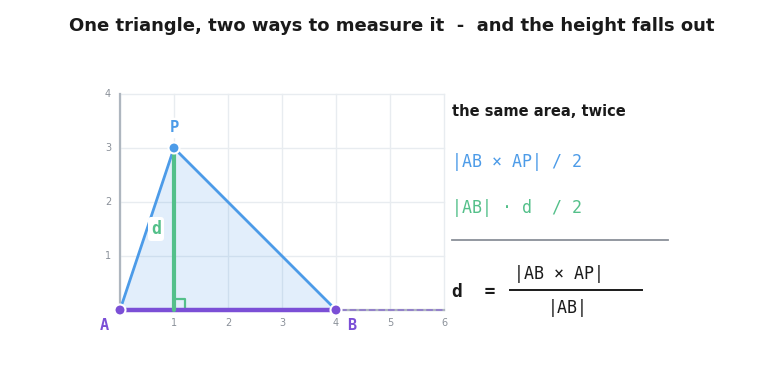
We already know two ways to write the area of the triangle ABP:
- with the cross product:
- the way we learned in school:
Take AB as the base, and the height is exactly the perpendicular distance we are after. One area, two expressions, so:
The absolute value is there because the cross product is signed and a distance is not.
Distance to a segment
A segment stops, so the perpendicular is only sometimes the answer - the closest point can also be A or B itself. The shadow tells us which of the three it is:
dot(AB, AP) <= 0=> the shadow falls behindA, soAis closestdot(AB, BP) >= 0=> it reaches pastB, soBis closest- otherwise => the perpendicular lands on the segment
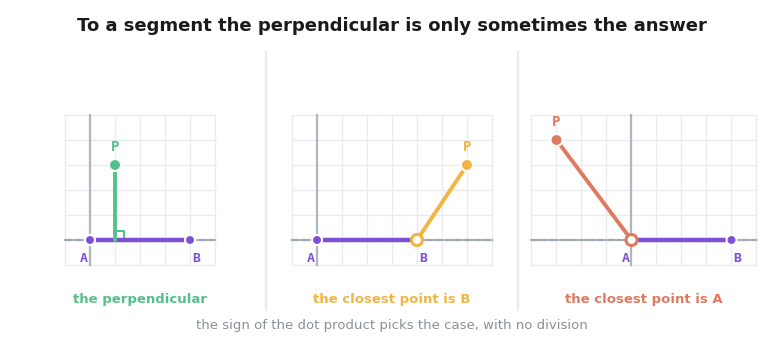
Both tests are integer dot products, so picking the case costs us no precision. The only real number in the whole function is the distance we return.
#include <bits/stdc++.h>

using namespace std;

struct v{

    long long x, y;
};

v sub(v a, v b){

    return {a.x - b.x, a.y - b.y};
}

long long cross(v a, v b){

    return (a.x * b.y) - (a.y * b.x);
}

long long dot(v a, v b){

    return (a.x * b.x) + (a.y * b.y);
}

double len(v a){

    return sqrt((double)(a.x * a.x + a.y * a.y));
}

double distToLine(v a, v b, v p){

    return abs((double)cross(sub(b, a), sub(p, a))) / len(sub(b, a));
}

double distToSegment(v a, v b, v p){

    if(dot(sub(b, a), sub(p, a)) <= 0){ //the shadow falls behind a
        return len(sub(p, a));
    }

    if(dot(sub(b, a), sub(p, b)) >= 0){ //the shadow reaches past b
        return len(sub(p, b));
    }

    return distToLine(a, b, p); //the perpendicular lands on the segment
}

int main(){

    cout<<fixed<<setprecision(4);

    v a = {0, 0};
    v b = {4, 0};

    cout<<distToLine(a, b, {1, 3})<<" "<<distToSegment(a, b, {1, 3})<<'\n';
    cout<<distToLine(a, b, {6, 3})<<" "<<distToSegment(a, b, {6, 3})<<'\n';
    cout<<distToLine(a, b, {-3, 4})<<" "<<distToSegment(a, b, {-3, 4})<<'\n';
    cout<<distToLine(a, b, {2, 0})<<" "<<distToSegment(a, b, {2, 0})<<'\n';

    return 0;
}
Output:
3.0000 3.0000
3.0000 3.6056
4.0000 5.0000
0.0000 0.0000
The middle two rows are where the two functions part ways: (6, 3) is past the end, so the closest point is B, and (-3, 4) is off the back, so it is A.
Where two lines meet
Describe the first line as a walk starting at A:
so t = 0 puts us at A, t = 1 at B, and t = 0.5 exactly halfway. Finding the crossing point means finding one number, t:
Both halves are integer cross products, with a single division right at the end. That is the best we could do - the answer really can be a fraction.
The denominator also warns us when not to divide. It is zero exactly when the two directions are parallel:
- not zero => the lines meet at exactly one point
- zero, and
Cis not on lineAB=> parallel, they never meet - zero, and
Cis on lineAB=> the same line written twice
struct point{

    double x, y;
};

int lineIntersection(v a, v b, v c, v d, point &out){ //1 one point, 0 parallel, -1 same line

    v ab = sub(b, a);
    v cd = sub(d, c);

    long long den = cross(ab, cd);

    if(den == 0){
        return (cross(ab, sub(c, a)) == 0) ? -1 : 0;
    }

    double t = (double)cross(sub(c, a), cd) / den;

    out = {a.x + t * ab.x, a.y + t * ab.y};

    return 1;
}

int main(){

    cout<<fixed<<setprecision(2);

    v a = {0, 0};
    v b = {4, 4};

    point p;

    cout<<lineIntersection(a, b, {0, 4}, {4, 0}, p)<<" "<<p.x<<" "<<p.y<<'\n';
    cout<<lineIntersection(a, b, {0, 10}, {10, 0}, p)<<" "<<p.x<<" "<<p.y<<'\n';
    cout<<lineIntersection(a, b, {1, 0}, {5, 4}, p)<<'\n';
    cout<<lineIntersection(a, b, {2, 2}, {6, 6}, p)<<'\n';

    return 0;
}
Output:
1 2.00 2.00
1 5.00 5.00
0
-1
Both of the first two rows are a single crossing point, and the difference matters: (2, 2) is in the middle of AB, while (5, 5) is well past B. This function answers about lines, and lines do not stop.
Note:
There is a second way to write a line, , with , and . Plugging a point into the left side gives back exactly the orientation cross product, with the line-only parts computed once ahead of time. Handy when one line is tested against very many points.
Keeping it exact
Once a double has been through a division it has stopped being a whole number, and every comparison after that is a guess. Two habits prevent it.
Do not compute the point when the question is not about the point.
"Is the crossing inside the segment AB" just means , and t is a fraction of two integers we already have:
long long num = cross(sub(c, a), cd);
long long den = cross(ab, cd);

if(den < 0){ //keep the denominator positive so the comparison does not flip
    num = -num;
    den = -den;
}

bool insideAB = (0 <= num && num <= den);
Do not take a square root just to compare two distances.
For one fixed line is the same positive number in both, so comparing alone gives the same ordering. Across different lines the exact comparison needs fourth powers of the coordinates, which overflow long long long before they reach - there the double is the safer choice.
The rule underneath all of it: signs are exact, measurements are not. Push the division as far towards the final answer as it will go.