Prime Factorization
In this lesson we will learn how to break any number down into its prime building blocks!
Every whole number greater than 1 can be written as a product of prime numbers, in exactly one way.
For example:
84 = 2 * 2 * 3 * 7
97 = 97 (already prime)
360 = 2 * 2 * 2 * 3 * 3 * 5
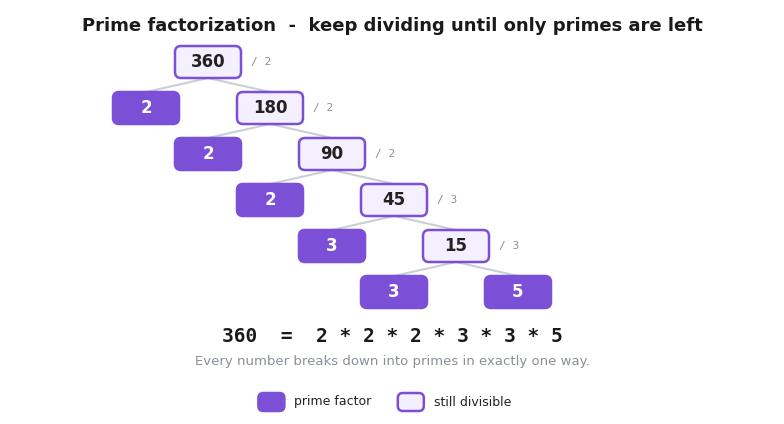
This is called the prime factorization of a number, and it is so fundamental that mathematicians named the rule the Fundamental Theorem of Arithmetic.
Theory
In order to find the factorization, all we have to do it repeatedly divide the numbers
We go through candidates d = 2, 3, 4... and for each one:
- While
ddividesn- printd, and dividenbyd
By dividing n immediately, we make sure each prime is printed as many times as it appears in the factorization.
This simple algorithm only prints prime numbers, that is because every non-prime number was already printed as a product of smaller primes.
Ex: 18 = 2 * 2 * 2 * 3
6 divides 18, but it is not present, because it is there in the form of 2 * 3
One more trick
Just like with the prime check last lesson, we only need to try d up to sqrt(n).
That is because a number n can have at most one prime factor larger than sqrt(n) (two of them multiplied together would already be bigger than n).
So after the loop finishes, if n is still greater than 1 - whatever is left is that one big prime factor, and we print it directly.
Implementation
#include <bits/stdc++.h>

using namespace std;

int main(){

    long long n;
    cin>>n;

    for(long long d = 2; d * d <= n; d++){

        while(n % d == 0){ //while d divides n

            cout<<d<<" ";
            n = n / d;
        }
    }

    if(n > 1){ //what remains is a prime factor larger than sqrt(n)
        cout<<n;
    }

    return 0;
}
Input: 84
Output: 2 2 3 7
Input: 97
Output: 97
Input: 360
Output: 2 2 2 3 3 5
Time complexity: O(sqrt(n))
Note:
Try removing theif(n > 1)check and factorizing97. The program prints nothing! The loop never finds a divisor because 97 is prime, so the leftover check is what saves us.