Two Pointers
In this lesson we will learn about one of the most basic, yet efficient optimization techniques : the two-pointer technique
Despite being called two pointers, this has nothing to do with the data type called "pointer" (more on them in another lesson).
This technique is essentially a unique way to traverse arrays that would usually require comparing every element with every other element.
In order to demonstrate how it works, let's look at a problem:
Problem
Given a number k and a sorted array of integers, if there exist two elements whose sum equals k, print them; otherwise, print "-1".
Brute force solution
The brute force solution is pretty simple, two nested for loops.
Essentially: "For every element of the array, check if that element and another element add up to k"
#include <bits/stdc++.h>

using namespace std;

int main(){

    cin.tie(0);
    ios_base::sync_with_stdio(false);

    int n,k;

    cin>>k;
    cin>>n;

    vector<int> a(n);

    for(int i=0;i<n;i++){
        cin>>a[i];
    }

    for(int i=0;i<n;i++){
        for(int j=i+1;j<n;j++){
            if(a[i] + a[j] == k){
                cout<<a[i]<<" "<<a[j];
                return 0;
            }
        }
    }

    cout<<-1;

    return 0;
}
The time complexity of this solution is O(n^2), but we can do better
Two pointers
Instead of comparing every element with every other element, we can traverse the array in a much smarter way.
-
Place one pointer at the beginning of the array:
int left = 0; -
Place the second pointer at the end of the array:
int right = n - 1; -
Then check whether:
a[left] + a[right] == k
If this condition is true - we found the solution. -
If the sum is not equal to
k, we check whether:a[left] + a[right] > kIf this is true, there is no need to continue checking the element
a[right].Since the array is sorted,
a[left]is currently the smallest number we are considering. If even with that smallest number the sum is already too large, then every element to the right ofleftwill produce an even larger sum.That is why we can safely move the right pointer to the left:
right = right - 1; -
The next case is:
a[left] + a[right] < kNow the problem is the opposite - the sum is too small.
Since
a[right]is the largest number we are currently using, no other element together witha[left]can produce a large enough sum.Therefore, we move the left pointer to the right:
left = left + 1; -
We repeat this process until:
- we find the solution
- or the pointers meet:
while(left < right)
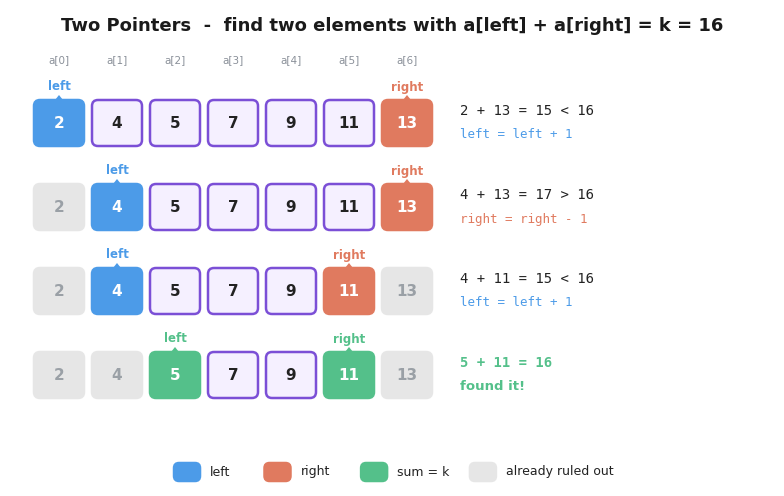
When we translate this idea into code, we get:
#include <bits/stdc++.h>

using namespace std;

int main(){

    cin.tie(0);
    ios_base::sync_with_stdio(false);

    int n,k;

    cin>>k;
    cin>>n;

    vector<int> a(n);

    for(int i=0;i<n;i++){
        cin>>a[i];
    }

    int left = 0;
    int right = n-1;

    while(left < right){

        if(a[left] + a[right] == k){

            cout<<a[left]<<" "<<a[right];
            return 0;

        }else if(a[left] + a[right] > k){

		    right = right - 1;

        }else if(a[left] + a[right] < k){

            left = left + 1;
        }

    }

    cout<<-1;

    return 0;
}
The time complexity of this solution is O(n).
Note: If the array weren't sorted, the bure force solution would remain O(n^2), but the 2 pointer one would have to account for sorting which is O(n log n)