Graphs
In this lesson we will learn about graphs - the structure hiding behind google maps, networks, and a huge share of the problems you will ever solve.
So far our data has been a line of values (a vector) or a rectangle of them (a matrix). Both work because the shape is fixed.
But look at a road map. Some cities have one road leading out, some have five. There is no row and no column - what matters is only who is connected to whom.
That is a graph, and once you can see it, you start seeing it everywhere: cities and roads, people and friendships, pages and links, states of a puzzle and the moves between them.
Vertices and edges
A graph is two things:
- vertices (also called nodes) - the things themselves, drawn as circles
- edges - the connections between them, drawn as lines
Two vertices joined by an edge are neighbours.
The number of edges leaving a vertex is its degree.
For this whole chapter we will use one graph: 7 cities, joined by the roads 1-2, 1-3, 2-4, 2-5, 3-6, 5-7 and 6-7.
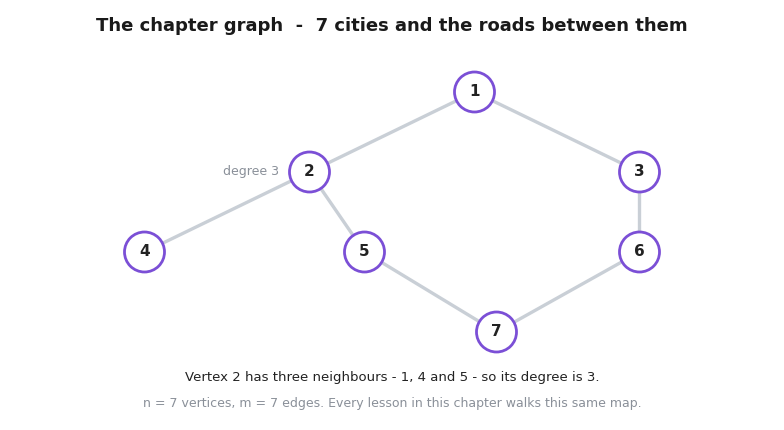
A few more words we will need:
- a path is a sequence of vertices where each one is a neighbour of the next:
1 2 5 7is a path - a cycle is a path that returns to where it started:
1 2 5 7 6 3 1 - a graph is connected if there is a path between every pair of vertices
Throughout the chapter, n is the number of vertices and m is the number of edges.
Kinds of graphs
Problems describe graphs in different flavours, and the wording tells you which one you have:
- Undirected - an edge works both ways (a road).
- Directed - it works one way only (a one-way street, a "follows" on social media).
- Unweighted - every edge is the same (a road is a road).
- Weighted - each edge carries a number (length, cost, time).
This chapter is entirely undirected and unweighted. Everything here still applies to the other kinds, with small changes we will make when we get to them.
The adjacency list
We need to store the graph in a way that answers the question we actually ask: who are the neighbours of v?
The answer is a vector of vectors. adj[v] is the list of neighbours of v, and nothing else.
#include <bits/stdc++.h>

using namespace std;

int main(){

    int n, m;
    cin>>n>>m; //n cities, m roads

    vector<vector<int>> adj(n+1); //adj[v] holds the neighbours of v

    for(int i=0;i<m;i++){

        int u, v;
        cin>>u>>v;

        adj[u].push_back(v);
        adj[v].push_back(u); //the road goes both ways
    }

    for(int v=1;v<=n;v++){

        cout<<v<<": ";
        for(int i=0;i<adj[v].size();i++){
            cout<<adj[v][i]<<" ";
        }
        cout<<'\n';
    }

    return 0;
}
Input:
7 7 - n and m
1 2
1 3
2 4
2 5
3 6
5 7
6 7
Output:
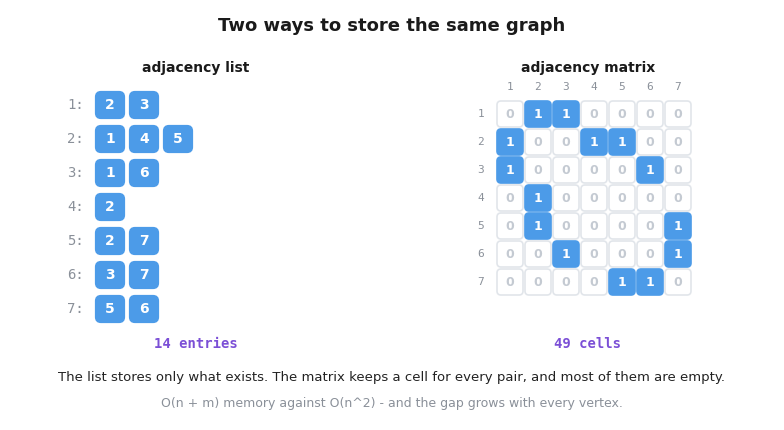
1: 2 3
2: 1 4 5
3: 1 6
4: 2
5: 2 7
6: 3 7
7: 5 6
Two details worth noticing. We size the vector n+1 so that vertex 1 sits at index 1 - almost every problem numbers vertices from 1, and fighting that only creates bugs. And we push the edge twice, once in each direction, because the road is undirected.
Memory is O(n + m), and listing the neighbours of v costs exactly as much as v has neighbours. This is the representation you should reach for by default.
The adjacency matrix
Sometimes the question is different: is there an edge between u and v? With an adjacency list that means scanning adj[u]. With a matrix it is one lookup.
g[u][v] is simply true when the edge exists.
#include <bits/stdc++.h>

using namespace std;

int main(){

    int n, m;
    cin>>n>>m;

    vector<vector<bool>> g(n+1, vector<bool>(n+1, false));

    for(int i=0;i<m;i++){

        int u, v;
        cin>>u>>v;

        g[u][v] = true;
        g[v][u] = true;
    }

    cout<<g[1][3]<<'\n'; //is there a road between 1 and 3?
    cout<<g[1][4]<<'\n'; //and between 1 and 4?

    return 0;
}
Input:
7 7 - the same 7 roads as above
Output:
1
0
The price is memory. The matrix is cells whether the graph has a million edges or three, which caps it at roughly n = 5000. It also cannot list the neighbours of v without checking all n cells in the row.
| Adjacency list | Adjacency matrix | |
|---|---|---|
| Memory | O(n + m) | O(n^2) |
Neighbours of v |
O(degree of v) | O(n) |
Is u-v an edge? |
O(degree of u) | O(1) |
| Good when | almost always | n is small and the graph is dense |
Note:
A graph withnvertices can have up to edges. Whenmis close to that the graph is called dense, and when it is far below - which is the usual case - it is sparse. The adjacency list is built for sparse graphs, which is why it wins almost every time.