Maps
In this lesson we will learn about a data structure used to efficiently link one value to another - maps (also known as dictionaries or heaps)
Imagine we are given n numbers and we have to count how many times each of them appears.
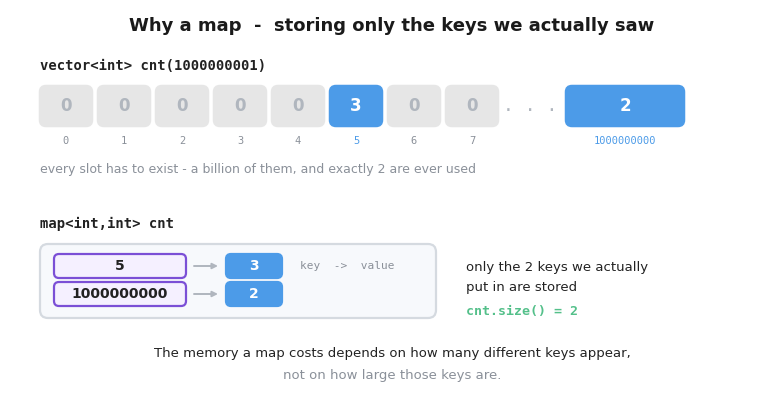
For small numbers we already know the trick from Counting Sort: make an array cnt and do cnt[x]++. But what if the numbers go up to ? An array of a billion elements does not fit in memory - even though at most n of its slots would ever be used.
What we need is something that stores only the keys we actually saw. That is exactly what a map does.
Pairs
Before the map itself, we need one small tool: the pair. A pair glues two values into a single object:
Example:
int main(){

    pair<string, int> p = {"Ana", 17};

    cout<<p.first<<'\n';  //the first value
    cout<<p.second<<'\n'; //the second value

    p.second = 18; //we can change them

    cout<<p.second;

    return 0;
}
Output:
Ana
17
18
The two values do not have to be of the same type, and we reach them with .first and .second. Pairs can be stored in vectors, compared and sorted (first by .first, and only then by .second) - but right now we need them for one reason: a map is built out of pairs.
What is a map?
A map stores key - value pairs. The key is what we look something up by, and the value is what we get back.
Think of a real dictionary: the word is the key, the definition is the value.
The important part is that the key can be almost anything - a number as large as we want, a string, even a pair. A map does not reserve a slot for every possible key; it keeps only the ones we actually put in.
Initialization: map<key_type, value_type> m, for example map<string, int> age.
The functions
| Function | What it does | Complexity |
|---|---|---|
m[k] |
the value stored under key k |
O(log n) |
m[k] = v |
stores value v under key k |
O(log n) |
count(k) |
returns 1 if key k exists, 0 if it does not |
O(log n) |
erase(k) |
removes key k together with its value |
O(log n) |
size() |
number of keys inside | O(1) |
empty() |
returns true if the map is empty |
O(1) |
clear() |
removes everything | O(n) |
Here n is the number of keys currently in the map. Notice that nothing is O(1) any more - that log is the price we pay for keys that can be anything.
Example:
int main(){

    map<string, int> age;

    age["Ana"] = 17;
    age["Marc"] = 20;

    age["Ana"]++; //Ana had a birthday

    cout<<age["Ana"]<<'\n';
    cout<<age.size()<<'\n';
    cout<<age.count("Marc")<<'\n';
    cout<<age.count("John");

    return 0;
}
Output:
18
2
1
0
The default value trap
Notice that we wrote age["Ana"]++ without ever setting age["Ana"] to 0 first. That works because a key which has never been used starts at the default value of its type - 0 for numbers, an empty string for strings.
Very convenient, but it hides a trap: simply reading m[k] creates the key.
![Three states of a map showing that reading m[7] inserts key 7 with value 0 and grows size from 1 to 2, while m.count(7) answers the same question and leaves the map unchanged](/lesson-images/map-default-trap.png)
Example:
int main(){

    map<int, int> m;

    m[5] = 1;

    cout<<m.size()<<'\n';

    if(m[7] == 0){ //we only wanted to check!
        cout<<"7 is not here"<<'\n';
    }

    cout<<m.size(); //but 7 got created anyway

    return 0;
}
Output:
1
7 is not here
2
That extra key is not just untidy - it costs memory, and it can silently break a loop that goes through the map later. When we only want to check whether a key exists, we use count(k), which never creates anything.
Counting occurrences
With all of that, the problem from the beginning becomes three lines:
Example:
int main(){

    vector<int> a = {1000000000, 5, 5, 1000000000, 5};

    map<int, int> cnt;

    for(int i=0;i<a.size();i++){
        cnt[a[i]]++;
    }

    cout<<cnt[5]<<'\n';
    cout<<cnt[1000000000];

    return 0;
}
Output:
3
2
The map holds exactly 2 keys, no matter how large the numbers themselves are. The memory we spend depends on how many different values appear, not on how big they are.
Going through a map
A map keeps its keys sorted at all times. Walking through it gives us the keys in increasing order, and every step hands us one pair:
Example:
int main(){

    map<string, int> cnt;

    cnt["banana"] = 2;
    cnt["apple"] = 5;
    cnt["cherry"] = 1;

    for(auto p : cnt){
        cout<<p.first<<" -> "<<p.second<<'\n';
    }

    return 0;
}
Output:
apple -> 5
banana -> 2
cherry -> 1
auto tells the compiler to work out the type on its own - here p is a pair of a string and an int. Note also that p is a copy of the pair, so changing it changes nothing inside the map. If we want to modify the values while walking, we write for(auto &p : cnt).
unordered_map
Keeping everything sorted is not free. When we do not care about the order, unordered_map does the same job using a hash table:
map |
unordered_map |
|
|---|---|---|
| Order of keys | sorted | arbitrary |
| Lookup, insert, erase | O(log n) | O(1) on average |
| Keys it accepts | anything comparable with < |
anything hashable (pairs do not work out of the box) |
The interface is identical, we only swap the name: unordered_map<string, int> age.
So unordered_map is faster on average... . The catch is that O(1) is only an average. In the worst case, when many keys land in the same bucket, it degrades all the way to O(n) per operation. On sites where other people write the tests, this is a well known way to break solutions - someone constructs an input in which the keys collide on purpose.
Note:
Rule of thumb: reach formapwhen you need the keys in order, or when the keys are pairs. Reach forunordered_mapwhen you only need raw speed and nobody is writing tests against you. When in doubt, the honest O(log n) ofmapis the safer choice.