Modified Sieve
In this lesson we will learn how to do prime factorization in O(log n) with some setup
When we want to factorize a large number of numbers, it is inefficient to do then one my one in O(sqrt(n)).
Instead we will setup a special kind of Sieve in O(max(n)) that will drastically speed things up.
The setup
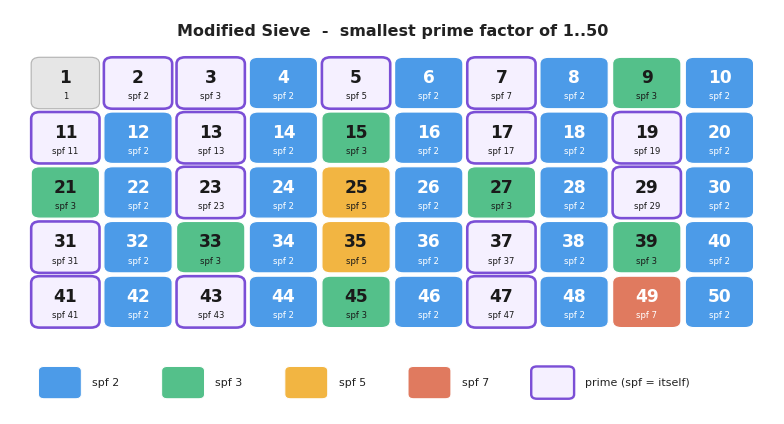
The idea is simple, for each number, keep their smallest prime divisor!
Similarly to a regular Sieve. Create an array sieve of size n where sieve[i] = i then:
- Take the smallest number where
sieve[i] = i- it is prime. - For all of its multiples, if they haven't been changed (if
sieve[j] == j), setsieve[j] = i- their smallest prime divisor isi. - Repeat.
Wherever sieve[i] == i that number is prime.
Here is the finished sieve for the first 50 numbers. Each cell shows the number and the smallest prime factor stored for it. Primes are the outlined cells, where sieve[i] == i:
The Factorization
Now every number x can be factorized by repeatedly dividing it by sieve[x], and keeping track of what divided it.
Repeat this process while(x > 1)
For example 36:
| x | sieve[x] | prime factors | New x |
|---|---|---|---|
| 36 | 2 | 2 | 18 |
| 18 | 2 | 2,2 | 9 |
| 9 | 3 | 2,2,3 | 3 |
| 3 | 3 | 2,2,3,3 | 1 |
The code
We build the sieve once into a global array, then reuse it for as many queries as we like. create_sieve fills sieve[x] with the smallest prime divisor of x, and factorize reads that array to break any x apart:
#include <bits/stdc++.h>
using namespace std;

const int N = 1000000; // build the sieve up to N
vector<int> sieve(N + 1); // sieve[x] = smallest prime divisor of x

void create_sieve(){
    for(int i = 1; i <= N; i++){
        sieve[i] = i; // start: assume x is its own smallest divisor
    }

    for(int i = 2; i * i <= N; i++){
        if(sieve[i] == i){ // i was never touched -> i is prime

            for(int j = i * i; j <= N; j += i){

                if(sieve[j] == j){ // j not touched yet
                    sieve[j] = i; // i is j's smallest prime divisor
                }
            }
        }
    }
}

vector<int> factorize(int x){
    vector<int> primes;

    while(x > 1){

        int p = sieve[x]; // smallest prime divisor of x

        while(x % p == 0){ // pull out every copy of p
            primes.push_back(p);
            x /= p;
        }
    }

    return primes;
}

int main(){
    create_sieve(); // one-time setup

    int x = 36;
    vector<int> factors = factorize(x); // reuse the sieve for any x

    cout << x << " = ";
    for(int i = 0; i < factors.size(); i++){

        cout << factors[i];

        if(i + 1 < factors.size()) cout << " * ";
    }

    cout << "\n";

    return 0;
}
Output: 36 = 2 * 2 * 3 * 3
Time complexity:
create_sieve - O(N log log N) which is around O(N), and N is maximum element
factorize - each call is O(log x)