Time Complexity
This lesson will focus on learning what time complexity is, and how to think about it when solving problems
A common issue in competitive programming is having a completely correct solution that still fails - with the verdict TLE (Time Limit Exceeded).
This happens because judges don't only check that the answer is right, they also give every problem a time limit (usually around 1 second). if your solution needs more than that, being correct won't save it.
A modern computer can do roughly 10^8 (100 million) basic operations per second.
Time complexity describes the relationship between input size and how the runtime of an algorithm grows.
The O( ) notation
We write time complexity using the O( ) notation (read "big O") - inside the parentheses we put, roughly, how the number of operations grows with the input size n. So O(n) means "about n operations", and O(n^2) means "about n·n operations".
Exact constants are ignored - doing 2n or n+10 operations is still just O(n). This might seem sloppy, but it is the whole point: when n is 1 000 000, the difference between n and 2n is nothing compared to the difference between n and n².
One more symbol you'll meet is log n - unlike in maths, in programming log means logarithm with base 2, or the number of times you can cut n in half before reaching 1.
Counting operations
So how do we find the complexity of our code? Treat every simple line (an assignment, a comparison, an arithmetic operation, reading one value) as one operation, and count.
Code with no loops does a fixed handful of operations no matter what we feed it - that is O(1):
int main(){

	int a, b;
	cin >> a >> b;

	cout << a + b; // a couple of operations, whether the numbers are small or huge

	return 0;
}
Loops are where the counting starts. A loop multiplies everything inside it by the number of times it runs. One loop over n elements - about n operations, O(n):
for(int i = 0; i < n; i++){

	sum = sum + a[i]; // one operation, done n times
}
And when loops are nested, the multiplication happens again - the inner loop runs fully for every step of the outer one. Here is a full program that counts its own operations:
#include <bits/stdc++.h>

using namespace std;

int main(){

	cin.tie(0);
	ios_base::sync_with_stdio(false);

	int n;
	cin >> n;

	int sum = 0;
	for(int i = 0; i < n; i++){ // the outer loop runs n times
		for(int j = 0; j < n; j++){ // the inner loop runs n times for EACH i

			sum++; // so this line runs n * n times
		}
	}

	cout << sum;

	return 0;
}
Input: 5
Output: 25
The program literally prints n·n - the number of times the innermost line ran. This code is O(n^2).
When estimating complexity we only care about the parts that repeat, not the constants around them. Seen through "complexity glasses", the program above is just:
int main(){
	for(int i = 0; i < n; i++){
		for(int j = 0; j < n; j++){
		}
	}
}
In these examples the complexity was easy to see, but often it won't be - that's fine, because an exact count is never necessary. A good, thought-out guess is always sufficient.
The common classes
Most of the time our code lands in one of these categories, from fastest to slowest:
O(1)- runs at the same speed no matter the input sizeO(log n)- barely grows at all (log of a million is ~20)O(n)- scales linearly with the input sizeO(n log n)- linear times "almost free" - barely worse thanO(n)O(n^2)- quadratic scaling, only survives small inputs or generous time limitsO(n!), O(n^n), O(2^n)- exponential (or worse) - only for tiny inputs
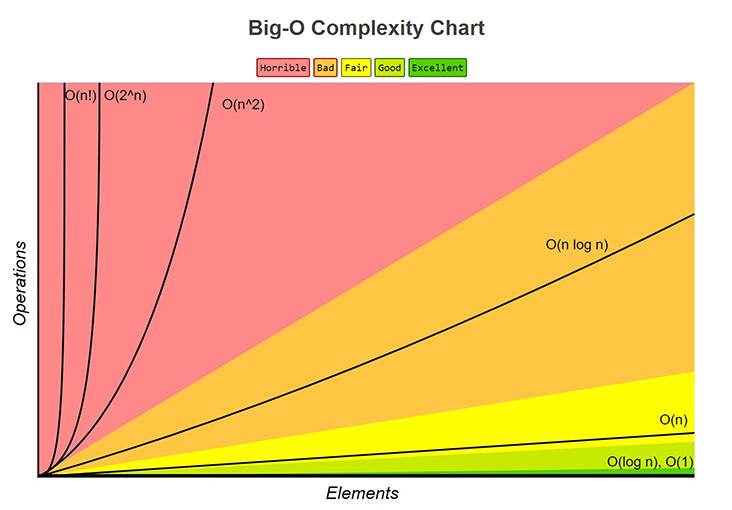
For most problems O(n log n) is the target.
How fast is fast enough?
Before writing any code, look at two things in the problem statement:
- The time limit
- The maximum input size (the constraints, e.g. "n ≤ 100 000")
Then take the worst case n, plug it into your guessed complexity, and compare against the 10^8 operations per second rule of thumb.
Let's say the time limit is 1 second and the constraints say n can be up to 100 000 (10^5):
- An
O(n^2)idea needs 10^5 · 10^5 = 10^10 operations - about 100 seconds. Hopeless, don't even write it. - An
O(n log n)idea needs about 10^5 · 17 ≈ 2 · 10^6 operations - a few milliseconds. Go for it.
Doing this five-second calculation before coding will save you from writing solutions that were doomed from the start. As a cheat sheet, for a typical 1 second limit:
- n ≤ 20 -
O(2^n)is fine - n ≤ 500 -
O(n^3)is fine - n ≤ 5 000 -
O(n^2)is fine - n ≤ 1 000 000 -
O(n log n)is fine - n larger than that - you need
O(n), or better
As you solve more and more problems, you'll be able to gauge what complexity works for what problem even without doing the math!