Binary Exponentiation
Binary Exponentiation ( Fast Exponentiation )
We want to compute a^b efficiently.
The intuitive solution is to write it as:
a * a * a * a... - b times
Which gets us the complexity of O(b), but there is a better way.
Lets look at an example, 3^10, using math we can rewrite it as:
3^10 = (3^5)^2
3^5 = 3 * 3^4
Again we repeat this process: 3^4 = (3^2)^2
And 3^2 = 3*3
Lets look at the whole equation now:
(3 * ( 3 * 3 )^2 )^2
If we count the operations, we get 5, compare to the 10 it would have taken if we multiplied by three 10 times
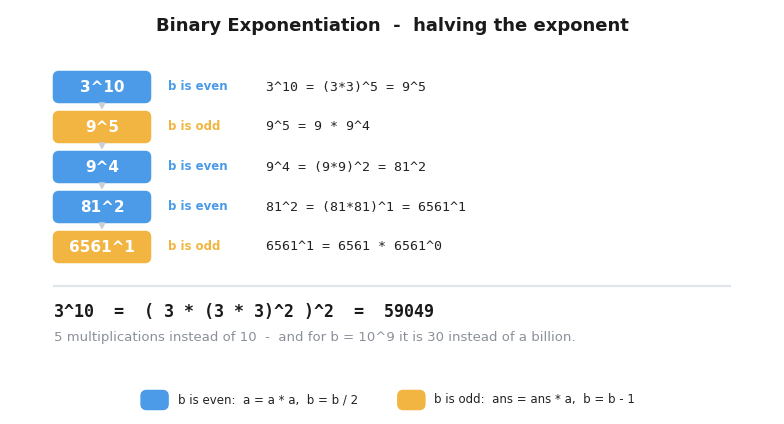
The larger the b, the more time we save by doing it this way.
For a general case, the algorithm looks like this ( ans = 1 at the beginning ):
- If
mis even, thena = a*aandb = b/2 - If
mis odd, thenans = ans * a, andb = b-1 - Repeat until
m<=0
The code looks like this:
Solution.cpp
#include <bits/stdc++.h>

using namespace std;

int main(){

    long long a = 3; //long long is like int, but it stores larger numbers
    long long b = 10;

    long long ans = 1;

    while(b > 0){

        if(b % 2 == 0){ // this tells us if b is even
            a = a*a;
            b = b/2;
        }else{
            ans = ans * a;
            b = b-1;
        }
    }

    cout<<ans;

	return 0;
}
Output: 59049
The complexity of this algorithm is O(log b)