Dijkstra's Algorithm
In this lesson we will learn about the most famous shortest paths algorithm - Dijkstra's Algorithm
Dijkstra's solves shortest paths for positive weighted graphs (graphs where traversing edges costs us something)
We can imagine this as cities and roads, where we want to find the shortest path from city A to city B.
We will be using this graph as an example:
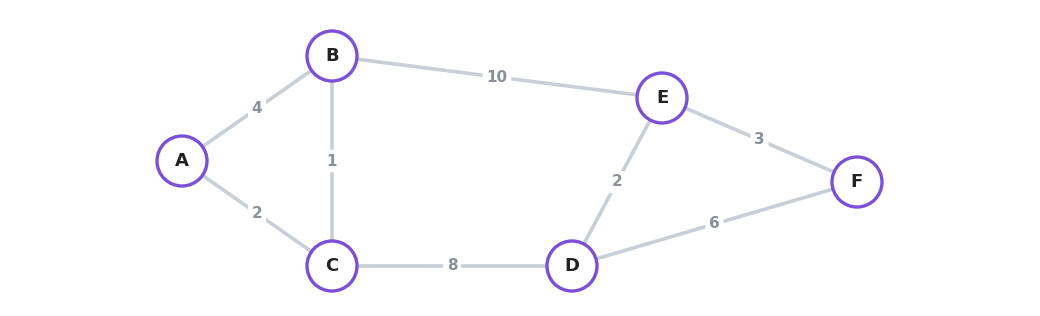
The number on a road is what it costs to drive it. BFS would count roads and answer A B E for getting to E, two roads - but that route costs 4 + 10 = 14, and going A C D E costs 2 + 8 + 2 = 12 even though it uses three roads. Counting is no longer enough.
It is very important that the graph contains only positive weights!
Theory
The main idea of Dijkstra's is that when we visit a node, it is guaranteed that we already know the shortest path to it.
Lets assume that at the start it takes us infinite time to get to each node.
Starting from A, to get from A to A costs us 0 (we are already there)
Now we go through all neighbors of A, and compare the current lowest distance of the neighbor with the distance we get by going through A.
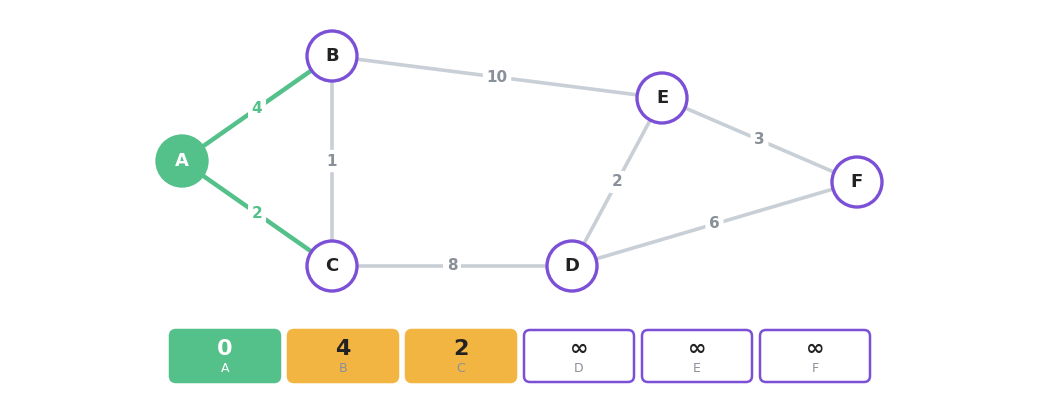
B and C were both at infinity, and any number beats infinity, so both improve. This comparison is called relaxing an edge, and it is the only thing Dijkstra's ever does to a distance.
The next node we will visit is the one with the shortest current distance!
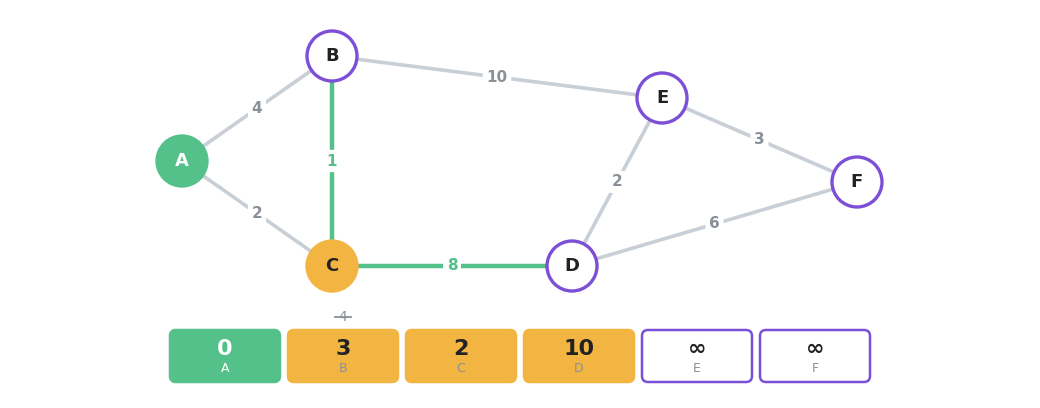
That is C with 2, not B with 4. And picking it pays off immediately: the road C-B costs 1, so reaching B through C costs 2 + 1 = 3, and the 4 we wrote down a moment ago is replaced.
This is why we never finish a node early. A distance stays provisional until its node is the smallest one left.
We repeat this process until all the nodes are visited.
Here is the final solution:
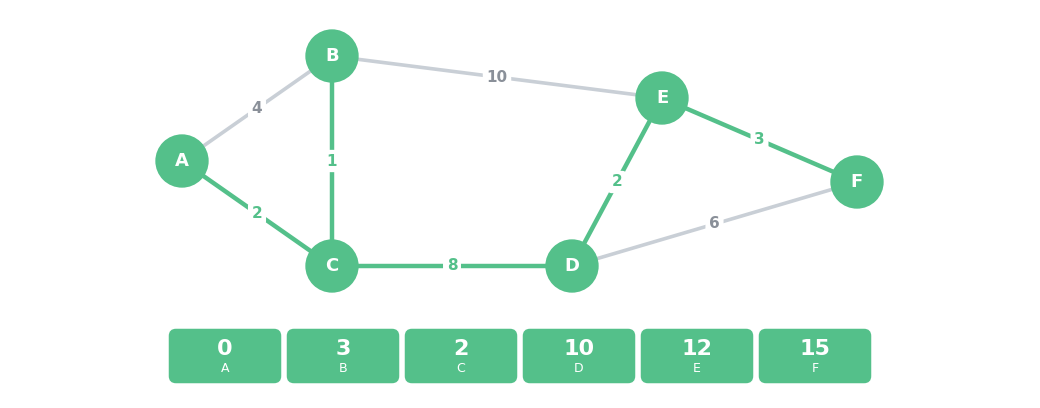
We can also stop our search when we get to the target node! (If we only wanted the shortest path from
AtoF, for example)
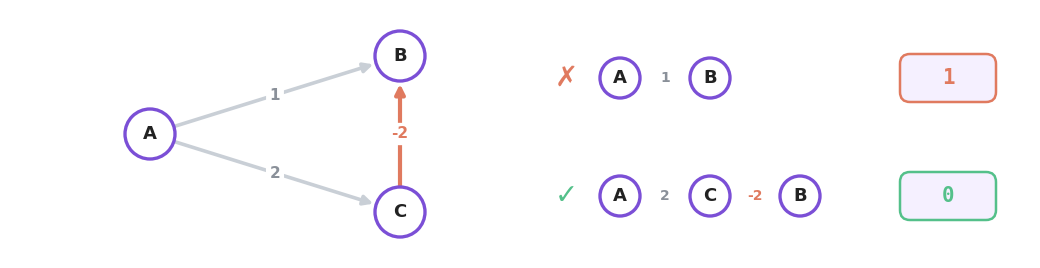
If the graph contained negative weights, our visit the shortest distance idea would greedily fail, and skip a possible shortcut!
Three cities are enough to break it. A reaches B for 1 and C for 2, and the road from C to B costs -2:
Implementation
A data structure that always keeps track of the lowest distance is a priority queue! (We will be using greater<>)
We need 3 things
- The already mentioned
priority_queue<pair<int,int>> pqwhich will store the node and its distance - A
vector<int> distwhich will store the distances - A vector of neighbors
vector<vector<pair<int,int>>> adjwhich stores the connections and weights
Now we just run a while loop until the priority queue is not empty!
Code
#include <bits/stdc++.h>

using namespace std;

int n = 6;
vector<vector<pair<int,int>>> adj(n); //adj[u] holds pairs (neighbour, weight)
vector<int> dist(n, 1e9); //1e9 stands in for infinity

void addEdge(int u, int v, int w){
    adj[u].push_back({v, w});
    adj[v].push_back({u, w});
}

void dijkstra(int start){

    priority_queue<pair<int,int>, vector<pair<int,int>>, greater<>> pq; //(distance, node)

    dist[start] = 0;
    pq.push({0, start});

    while(!pq.empty()){

        int d = pq.top().first;
        int v = pq.top().second;
        pq.pop();

        if(d > dist[v]){ //an old entry, we already found something better
            continue;
        }

        for(int i=0;i<adj[v].size();i++){

            int to = adj[v][i].first;
            int w = adj[v][i].second;

            if(dist[v] + w < dist[to]){ //going through v is cheaper
                dist[to] = dist[v] + w;
                pq.push({dist[to], to});
            }
        }
    }
}

int main(){

    addEdge(0,1,4);  //A-B
    addEdge(0,2,2);  //A-C
    addEdge(2,1,1);  //C-B
    addEdge(2,3,8);  //C-D
    addEdge(1,4,10); //B-E
    addEdge(3,4,2);  //D-E
    addEdge(3,5,6);  //D-F
    addEdge(4,5,3);  //E-F

    dijkstra(0);

    for(int v=0;v<n;v++){
        cout<<(char)('A'+v)<<": "<<dist[v]<<'\n';
    }

    return 0;
}
Output:
A: 0
B: 3
C: 2
D: 10
E: 12
F: 15
Time Complexity: O(m log n)
Space Complexity: O(n + m)
The pair is (distance, node) and not the other way around, because a priority_queue compares pairs by their first element. Putting the distance first is what makes it order by distance.
Note:
Reconstructing the route works exactly as it did with BFS: keep aparentarray, and writeparent[to] = von the same line where you improvedist[to].